

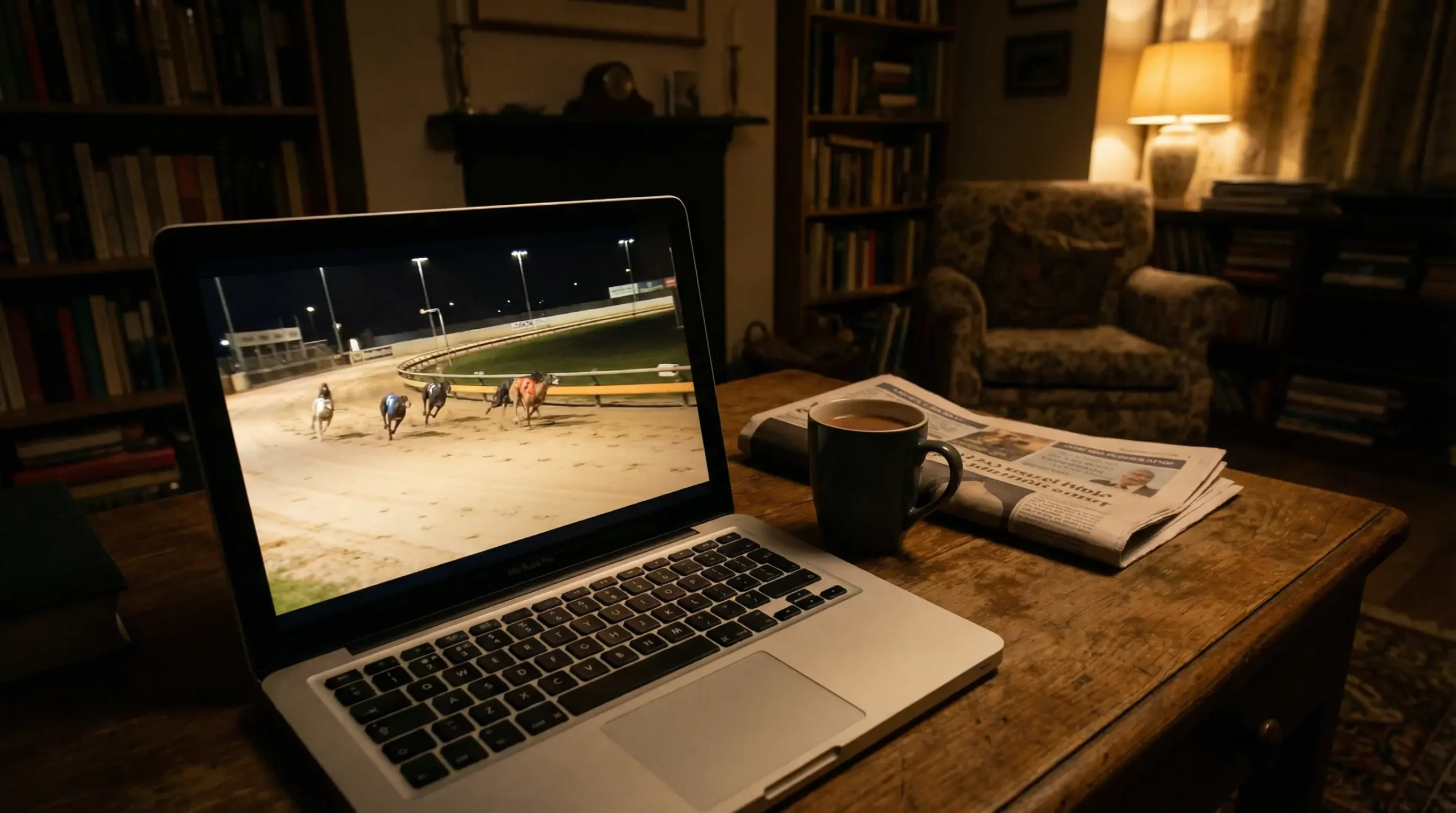
Watching the Race Changes How You Bet
There is a meaningful difference between reading a result and watching it happen. A form card tells you a dog finished third after being bumped on the first bend. A live stream shows you exactly how severe that bump was, whether the dog was travelling well before the interference, and how much ground it lost in recovery. One is data. The other is context. Together, they produce a more complete picture than either provides alone.
Live streaming has transformed how UK punters interact with greyhound racing. A decade ago, watching the dogs required either a trip to the track or a television subscription. Now, most major bookmakers offer free live streams of every UK meeting directly through their websites and apps. The barriers to watching have effectively disappeared — the only requirement in most cases is a funded account or a small qualifying bet on the race being shown.
For punters who are serious about form analysis, live streaming is not optional. It is the visual layer that complements written form data, and it provides information that the racecard cannot capture: running style, early pace behaviour, the dog’s physical condition in the parade ring, and the kind of trouble in running that form abbreviations only partially describe.
Free Live Greyhound Streaming: Which Bookmakers Offer It
The majority of licensed UK bookmakers with an online presence offer free live streaming of greyhound racing. The coverage is sourced primarily through two providers — SIS (Satellite Information Services) and Sky Sports Racing (SIS Racing) — and the streams are embedded directly into the bookmaker’s website or app. You do not need a separate subscription or a third-party player to watch.
Access requirements vary between operators, but the typical condition is either a funded account — meaning you have money deposited — or a qualifying bet placed on the race in question. Some bookmakers require both. The qualifying bet threshold is usually low, often as little as one penny or one pound, depending on the operator. The intent is to ensure the viewer is an active customer rather than a passive spectator, and for most punters who are already betting on the race, the requirement is met automatically.
Coverage depth also varies. Larger bookmakers tend to stream every UK meeting from every licensed GBGB track, morning to evening. Smaller operators may cover a subset of meetings or may only offer streams during peak hours. If comprehensive coverage matters to you — and it should, particularly if you specialise in a specific track — it is worth checking the streaming schedule across multiple bookmakers before settling on one as your primary viewing platform.
One practical advantage of streaming through a bookmaker rather than watching on television is integration. Most bookmaker streaming pages display the racecard, live odds, and the stream on the same screen. You can watch the race, check the form, and place a bet without switching between tabs or apps. That integration becomes particularly useful during busy evening cards where multiple tracks are running simultaneously and the time between races is short.
Irish greyhound meetings are also available through many UK bookmakers, which expands the viewing calendar further. Dogs that race in Ireland sometimes transfer to UK tracks, and having watched their previous Irish runs gives you a form perspective that the written card does not always convey.
SIS vs Sky Sports: Coverage Differences
The two primary providers of live greyhound coverage in the UK operate different broadcast models, and the distinction matters if you are relying on streams for form study. SIS provides the core racing feed for the majority of UK greyhound meetings. Their coverage is functional rather than editorial — clean camera angles, race commentary, and results delivery. SIS streams are widely available across bookmaker platforms and form the backbone of in-play greyhound viewing in the UK. Most evening and afternoon meetings at GBGB tracks are broadcast through the SIS network.
Sky Sports Racing offers a more produced package. Their greyhound coverage includes pre-race analysis, expert commentary, kennel visits, and feature segments around major events. The production quality is higher, and the editorial context — discussion of form, trainer interviews, track conditions — adds a layer of insight that the SIS feed does not typically provide. However, Sky Sports Racing’s greyhound schedule is more selective. They do not cover every meeting at every track. Major events, weekend cards, and feature races receive full production treatment, while smaller midweek meetings may not feature at all.
For betting purposes, the SIS feed is the more important of the two. It covers the broadest range of meetings, it is available through the most bookmakers, and its no-frills approach means you get the race footage without editorial interpretation that might bias your own analysis. Sky Sports Racing is valuable as a supplement — particularly around major events where the deeper coverage can surface information that casual form study misses — but it is not a replacement for the SIS streams that cover the daily card.
Stream quality can vary depending on your device, connection, and the bookmaker’s platform. Most streams run at a slight delay — typically between one and five seconds behind the live action — which is relevant if you are considering in-play betting. That delay means the market has already moved by the time you see the traps open. For form study and post-race analysis, the delay is irrelevant. For live betting, it is a structural disadvantage worth acknowledging.
How to Access Live Greyhound Racing Streams
The process is straightforward on every major platform. Open your bookmaker’s website or app, navigate to the greyhound racing section, and find the meeting you want to watch. Most platforms display a video icon or a “Watch Live” button next to races that are available for streaming. Click or tap the icon, meet whatever qualifying condition applies — usually a funded account or a small bet — and the stream loads directly within the page.
On desktop, streams typically appear in a player embedded alongside the racecard. The player is resizable on most platforms, and some bookmakers offer a pop-out window that lets you watch while navigating other parts of the site. On mobile, the stream usually occupies a fixed player at the top of the race page, with the card and betting options scrollable beneath it. The mobile experience is functional but smaller, which makes it harder to pick out detail during the race itself. If you are using streams for serious form analysis — watching running styles, spotting trouble, assessing early pace — a larger screen is noticeably better.
Timing matters. Streams go live a few minutes before the scheduled race time, and the pre-race footage typically includes the parade ring and trap loading. This pre-race window is useful for assessing the dogs’ physical condition — a dog that looks agitated or sluggish in the parade ring is providing real-time information that the form card cannot. Experienced track-goers have always used the parade ring as part of their assessment. Live streaming brings that same window to anyone watching from home.
One limitation to be aware of: streams are geographically restricted. Most UK bookmakers limit their live streams to customers accessing from within the UK or Ireland. If you are travelling or using a device outside those regions, the stream may not be available. This is a licensing condition imposed by the broadcasters, not a bookmaker choice, and there is no straightforward workaround.
Don’t Just Watch — Study
The trap that live streaming creates is passive consumption. It is easy to have a stream running in the background, watch the race in a half-attentive state, and feel like you are doing form work when you are really just watching television. The visual information that streams provide is only useful if you are watching with intention — looking for specific things, noting them down, and folding those observations into your next assessment of the same dogs.
When you watch a race, focus on three things. First, the break: how quickly does each dog leave the traps, and which ones gain or lose position in the first fifty metres? This tells you about early pace in a way that sectional times approximate but never fully capture. Second, the first bend: who gets checked, who gets a clean run, and which dogs lose ground to traffic they could not avoid? This is the information that form abbreviations like Bmp and Ck describe in shorthand, but that a visual replay renders in full. Third, the run-in: which dogs are finishing strongly and which are fading? A dog that is closing at the line but finishes third might be a better bet next time than the dog that won but was stopping.
The punters who extract the most value from live streaming are the ones who watch races they have already studied on paper. They have read the form, identified the key questions — does this dog handle the wide draw, is that one faster than its finishing position suggests — and they use the stream to answer those questions visually. Watching without preparation is entertainment. Watching with preparation is research. The stream is the same in both cases. The difference is in what you bring to it.
Stay updated with results at greyhoundresultsyester.
Also check our greyhound racing schedule UK.
