

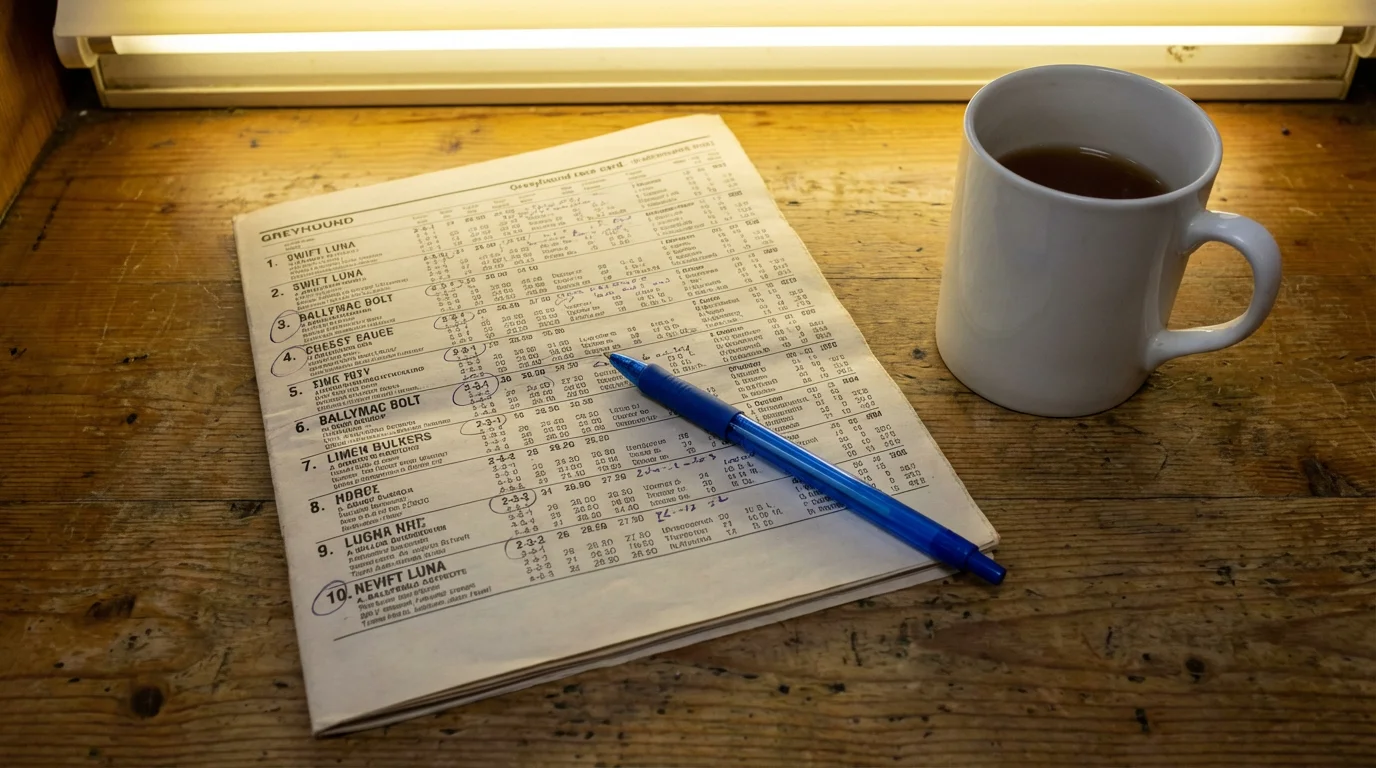
The Race Card Is a Betting Weapon — If You Can Read It
Every winning greyhound bet starts with the same thing: a race card that most punters glance at but never properly read. The card is a compressed biography of every dog in the race — its recent runs, its speed, its quirks in the traps, the name of the person who feeds it and trains it. All of that sits in a few lines of text and numbers, and the gap between the punter who understands it and the one who skips to the odds is enormous.
In horse racing, race cards come wrapped in narrative. There are jockeys to assess, going reports to interpret, lengthy commentary from paddock watchers and tipsters with opinions on headgear changes. Greyhound cards are stripped back by comparison. No jockey variable, no tack changes, no weighing room drama. What you get instead is raw data: form figures, times, trap draws, weights and abbreviations that tell you exactly what happened in each dog’s recent outings. The card doesn’t editorialise. It just reports.
That austerity is actually an advantage. Because the information is standardised across every GBGB-licensed track in the UK, a punter who learns to read one card can read them all. The format barely changes from Romford to Monmore, from a Tuesday afternoon sprint at Crayford to a Saturday night open race at Nottingham. Once you know what each column means, the card becomes a filter. It tells you which dogs belong in the conversation and which ones are making up the numbers.
This article breaks the card apart column by column, translates the abbreviation wall that puts off casual bettors, explains how sectional times reveal what finishing positions hide, and shows why trainer data deserves more attention than it usually gets. By the end, you should be able to look at a six-dog race card and extract a shortlist without needing anyone else’s opinion.
What Each Column on a Greyhound Race Card Means
A standard UK greyhound race card — whether you pull it up on Timeform, the Racing Post, or a bookmaker’s site — follows a consistent layout. Each dog gets a row, and each row contains roughly the same set of columns. The exact presentation varies slightly between platforms, but the underlying data is drawn from the same GBGB records. Here is what you will typically find, moving left to right across the card.
The first column is the trap number, displayed alongside the corresponding blanket colour. Trap 1 is red, Trap 2 blue, Trap 3 white, Trap 4 black, Trap 5 orange, and Trap 6 carries black and white stripes (GBGB Rule 118). This is not decorative — the trap number dictates where the dog starts relative to the inside rail, and for many dogs it is the single biggest factor in how they run. A confirmed railer drawn in Trap 6 has a problem before the lure even moves.
Next comes the dog’s name, often followed by its breeding (sire and dam) and its age. Breeding can be informative at open-race level where you might recognise bloodlines associated with stamina or early pace, but for standard graded racing, it is background information rather than a decisive factor. Age matters more. Greyhounds peak between two and four years old. A dog approaching its fifth birthday running in A3 grade is probably not about to improve.
The trainer column lists the licensed handler responsible for the dog’s preparation. This is more significant than many punters realise, and we will return to it in detail later. For now, note the name and be aware that certain trainers have markedly higher strike rates at specific tracks.
Then come the form figures — the most information-dense part of the entire card. These are typically the finishing positions from the dog’s last six runs, displayed in a sequence from oldest to most recent, left to right. A dog showing 321211 finished third, then second, then first, then second, first, and first again. That is a dog in good form with a clear upward trend. A dog showing 665443 is heading the other direction. The figures alone do not tell you everything — a first-place finish in A7 at Sunderland is not the same as a first in A1 at Hove — but they establish the trajectory.
Weight is listed in kilograms, usually to one decimal place. This is the dog’s race-day weight, and while greyhound weight does not fluctuate as dramatically as a human athlete’s, consistent trends matter. A dog that has gained a full kilogram over three runs might be carrying condition rather than muscle. A sharp drop in weight after a break from racing can indicate illness or disrupted preparation. The number itself is less important than the pattern.
The comment column — sometimes labelled as “remarks” — is where the in-running story of each previous race is condensed into a string of abbreviations. This is the part most casual punters skip entirely, and it is also where the most valuable information hides. Did the dog get bumped at the first bend? Was it slow out of the traps? Did it lead for most of the race and get caught late? All of this is recorded in shorthand. The abbreviations section below decodes the full set.
Finally, the card will show recent times — either the actual winning time, the calculated time (adjusted for the distance the dog finished behind the winner), or both. Some platforms also display a “best recent time” figure. These times are essential for comparing dogs within the same race, but they require context. A 29.50 over 480 metres at Romford is not the same as a 29.50 at Monmore. Track surfaces, configurations and timing systems differ, so cross-track time comparisons need careful handling.
Decoding Recent Form Figures and Run Positions
The six-figure form string is the quickest way to assess a dog’s recent trajectory, but reading it well requires more than just checking whether the numbers are going up or down. Each digit represents a finishing position out of six, which means a “3” is a mid-pack finish — neither good nor bad without context.
Start by looking at the most recent two or three runs, weighted to the right-hand side of the string. These are the freshest data points and carry the most predictive weight. If a dog’s last three runs read 1-1-2, it is clearly performing at or near the top of its current grade. If those same three runs read 5-6-4, you are looking at a dog that is struggling, regardless of what it did a month ago.
Look for patterns rather than individual digits. A sequence like 4-3-2-1 tells a story of steady improvement — possibly a dog that has been dropped a grade and is now finding its level. A sequence like 1-1-3-5 suggests the opposite: a dog that won when conditions suited and has since been raised to a grade where it cannot compete. Grade changes are the most common reason for sharp shifts in form figures, so always cross-reference the form string with the grade in which each run took place.
Dashes or letters in the sequence indicate non-completions or absences. A “-” typically means the dog did not run or there is no form for that slot. Some cards use “0” to indicate a run more than six places back (relevant in larger fields at Irish tracks, though UK greyhound races almost always feature six runners). The letter “T” may appear if the run was a trial rather than a competitive race.
One thing form figures cannot tell you is how the race unfolded. A dog that finished fourth might have been bumped at the first bend and lost three lengths through no fault of its own. Another dog that finished first might have led from trap rise on a night when every rival had trouble. The form figures are the headline; the comments column is the full report.
Race Times, Calculated Times and Track Standards
Every greyhound race produces a winning time — the clock from trap rise to the moment the first dog crosses the line. This number is useful but limited, because it only tells you how fast the winner ran. The other five dogs need a different measure.
That measure is the calculated time, sometimes called the “adjusted time” or “cal time.” It takes the winning time and adds a standard amount for each length the dog finished behind the winner. The standard increment is approximately 0.08 seconds per length (GBGB Rule 139) at sprint distances and slightly less over longer trips. So if the winning time was 29.40 over 480 metres and a dog finished three lengths back, its calculated time might be listed as 29.64. This gives every dog in the race a time-based performance figure, making direct comparison possible.
The catch is that these times are only directly comparable within the same track and distance. A 29.40 at Romford and a 29.40 at Towcester are not equivalent performances. Tracks differ in surface type, circuit configuration (two-bend versus four-bend), camber, trap mechanism speed, and timing system calibration. To compare across tracks, you need track standards — a benchmark time for each distance at each venue that represents a “par” performance for a given grade. Timeform and other data services publish these standards, and the best use of them is to see how far above or below par each dog has been running.
A dog that consistently runs half a length faster than track standard in A4 at Crayford is, on that measure, performing at a level closer to A3. If it gets regraded upward, the times already told you it could handle the step. Conversely, a dog running half a length slower than standard is vulnerable to being overtaken by dogs moving up from a lower grade. Track-standard-adjusted times are particularly useful when a dog switches venue — it gives you a framework for estimating how its form translates to an unfamiliar circuit.
Greyhound Form Abbreviations: The Complete Decoder
A wall of letters that separates the casual punter from the serious one. The comments column on a greyhound race card is written in a shorthand that looks impenetrable at first glance — but once you learn the vocabulary, it transforms from noise into signal. These abbreviations record what happened to each dog during the race, and they are often more valuable than the finishing position itself.
The abbreviations fall into three broad categories: trouble in running, position and pace, and track or circumstantial notes. Understanding all three turns the form book from a list of numbers into a story.
Trouble in running is where the hidden value sits. Bmp means the dog was bumped — physical contact with another runner, usually at a bend. Ck (checked) indicates the dog had to shorten its stride to avoid trouble, losing momentum and ground. Crd (crowded) describes a dog that was squeezed between runners with limited room to manoeuvre. SAw (slow away) tells you the dog was slow to leave the traps, losing early position. These are critical because they explain poor finishing positions that were not the dog’s fault. A dog that finished fifth but carries the annotation “Bmp1, Ck2” — bumped at the first bend, checked at the second — might have been the best dog in the race on ability. Next time out, with a clear run, that fifth-place finish could easily become a first.
Conversely, some trouble abbreviations suggest a recurring problem. A dog that shows SAw in three consecutive runs is not unlucky — it has a trapping issue. A dog that regularly shows W (wide) is drifting off the rail, covering extra ground every time. Patterns of trouble matter more than isolated incidents.
Position and pace abbreviations tell you how the race unfolded from each dog’s perspective. Led means the dog led at some point during the race, with a number indicating which section (Led1 = led at the first bend). EP (early pace) describes a dog that showed good speed in the opening section. MsDis (middle distance) indicates a dog that moved through the field in the middle portion of the race. RnOn (ran on) means the dog finished strongly in the closing stages. FinWl (finished well) carries a similar meaning. These terms help you understand a dog’s running style — whether it needs to lead from the front, whether it prefers to come from behind, and at which stage of the race it does its best work.
The third category covers track and circumstantial notes. RIs (ran in straight) tells you the dog was tested over the straight course rather than a bend track. Nrw (narrow) describes tight racing lines. Stb (stumbled) is self-explanatory. Fell indicates the dog went down during the race, which almost always makes the form line meaningless for future assessment. The note “Re” after a trap number means the dog was the reserve runner, called into the race when another dog was withdrawn.
A useful habit is to read the comments column before looking at the finishing position. If you see “Led1, Bmp2, Ck3, Fin4th” you already know this dog was leading until it got knocked sideways. The fourth-place finish understates its ability. Equally, if a dog shows “EP, Led, WnBy3” — early pace, led throughout, won by three lengths — the form figures will read “1,” but the comments tell you it dominated. That distinction matters when the dog steps up a grade or faces faster opposition.
No one memorises every abbreviation overnight. Most experienced punters carry the full list in their head after a few months of regular race card reading. Until then, keep a reference handy. The GBGB website publishes the official abbreviation key, and most data platforms include hover-over explanations for each code.
Sectional Times: The Hidden Layer of Greyhound Form
Overall time tells you who won — sectionals tell you why. A greyhound race, even a short sprint, breaks down into distinct phases: the exit from the traps, the run to the first bend, the bends themselves, and the run to the finish line. Each phase favours a different type of dog, and the sectional splits reveal which phase decided the result.
The most commonly available sectional is the split to the first bend, usually recorded from trap rise to a timing point roughly 100 to 150 metres into the race, depending on the track layout. This “first-bend split” is the single most revealing number on the card for sprint races. A dog that consistently posts a fast split to the first bend is an early-pace runner — it gets to the front quickly and forces everything else to chase. In a six-dog race around a tight two-bend track, being first to the bend is an enormous tactical advantage because it avoids the crowding and bumping that costs positions.
Run-in time — the split from the last bend to the finishing line — tells you about finishing speed. Dogs with strong run-in splits are closers. They may be mid-pack at the halfway stage but they accelerate when others are tiring. In stayer races over 600 metres or more, run-in speed is often the decisive factor, because the early pace burns off the sprinters and leaves the finish to the dogs with stamina reserves.
The relationship between the two splits is what makes sectional analysis genuinely powerful. A dog that posts a fast split to the first bend but a slow run-in is front-loaded — it leads early but fades late. If that dog is drawn inside in a sprint, it might hold on. Over a longer trip, or drawn wide where it has to cover extra ground to reach the lead, it is vulnerable. A dog with a slow first-bend split but a strong run-in is the mirror image: it needs a clear passage through the bends and a long enough straight to use its closing speed.
Comparing sectionals across different tracks requires the same caution as comparing overall times. A 5.80-second split to the first bend at Romford is not the same as 5.80 at Hove because the distance to the first timing point differs. Always compare within the same track and distance, or use track-standard-adjusted sectionals if your data source provides them.
Where sectional analysis pays the biggest dividends is in identifying dogs whose overall time flatters or misleads. A dog might post an impressive overall time, but if the sectionals reveal it was gifted a clear lead and cruised to the line unchallenged, the time tells you more about the weakness of the opposition than the strength of the winner. Conversely, a dog with a mediocre overall time that shows a fast run-in split after being checked twice at the bends is a much better animal than the clock suggests. That dog, given a trouble-free run, could knock several lengths off its recent time. These are exactly the kind of opportunities that the market undervalues, because most punters look at the headline time and move on.
Not every data platform provides sectional times as standard. Timeform is the most comprehensive source for UK greyhound sectionals. Some bookmaker race cards display them, though inconsistently. If you are serious about greyhound form analysis, access to sectional data is worth prioritising — it is the single biggest informational edge available to the everyday punter.
Trainer Data and Kennel Form
The handler matters more than most punters think. Greyhound racing has no jockey — the dog runs on instinct, fitness and preparation. That last element is entirely the trainer’s responsibility, and the variation in quality between kennels is significant enough to show up in the numbers.
Trainer strike rates — the percentage of runs that produce a win — are publicly available on platforms like Timeform and the Racing Post. The numbers vary widely. Some trainers operating at the top level at major tracks carry strike rates above 20 per cent. Others, particularly those handling large strings of dogs across multiple lower-grade meetings, sit closer to 10 or 12 per cent. Neither number is inherently better — a 12 per cent strike rate with a large string at good prices can be more profitable than a 22 per cent rate if the winners consistently go off at short odds. What matters for the punter is whether a trainer’s current form is above or below their long-term average.
Kennel form — the collective recent performance of all dogs under a trainer’s care — is a powerful short-term indicator. Trainers go through hot and cold streaks, just like any other participant in sport. A kennel that has sent out eight winners from thirty runners in the past fortnight is running at a significantly elevated rate, and the effect tends to cluster. Good preparation, peak fitness across the string, favourable track conditions — whatever the cause, the trend is real and worth following until the numbers cool off.
Trainer-track specialisms are another underused angle. Certain trainers dominate at specific venues because they know the track, they enter dogs suited to its configuration, and their preparation methods align with the surface and distances on offer. If you notice a trainer who consistently outperforms the field at a particular stadium, that is a data point worth incorporating. It does not guarantee success in any individual race, but it shifts the probability in a meaningful way over a series of bets.
A trainer change is a more dramatic signal. When a dog moves from one kennel to another, its form line effectively resets. The new trainer may feed the dog differently, alter its training routine, or run it over different distances. A dog that was struggling in A5 for one trainer might improve sharply under new management — or it might drop further. The first two or three runs after a trainer change are worth watching closely but not betting on blindly. Let the new form emerge before committing money.
The simplest way to use trainer data in practice is to add it as a final filter. After you have assessed the form figures, the times, the trap draw and the abbreviations, check the trainer column. If the dog you fancy is trained by a handler in good current form with a strong record at the track, that is a tick in the box. If the trainer has sent out nothing but also-rans for the past three weeks, it is worth asking whether the form you are reading is about to hit a wall.
Putting Form Reading Into Practice: A Worked Example
Theory is useful — let’s apply it to an actual race card. Imagine a standard A4 graded race over 480 metres at a two-bend track, six runners, Tuesday evening meeting. Here is a simplified version of what the card might show, and how you would work through it.
Trap 1 (Red): “Ballymac Flash.” Form figures 3-2-1-1-2-1. Weight 32.4kg (consistent across recent runs). Best recent time 29.55 (calculated). Comments from the last run: “EP, Led1, WnBy2.” Trainer strike rate at this track: 19 per cent, above his seasonal average. This dog has won three of its last six, all at this distance. It shows early pace, led at the first bend in its last run, and won comfortably. Drawn in Trap 1, the inside box — ideal for a railer with early speed. This is the obvious contender.
Trap 3 (White): “Droopys Thunder.” Form figures 5-4-6-3-2-2. Weight 34.1kg, up 0.6kg from two runs ago. Best recent time 29.68. Last run comment: “SAw, Bmp1, RnOn, Fin2nd.” Trainer on a cold streak (two winners from twenty-four runners in the past month). The form figures are improving — 6, 3, 2, 2 — but the last run comments reveal it was slow away, bumped at the first bend, and still ran on to finish second. That is a better performance than “second” suggests. However, the weight gain and the trainer’s cold streak are negatives. This dog is interesting but risky.
Trap 5 (Orange): “Kilkenny Star.” Form figures 1-1-3-4-5-6. Weight 31.8kg, down 0.4kg. Best recent time 29.42 — the fastest in the race on paper. Last run comment: “Led1, Crd2, Fdd.” Won its first two runs in this sequence, then a clear decline: third, fourth, fifth, sixth. The calculated time of 29.42 came from its first win, five runs ago. Its most recent calculated time is 30.10. This is a dog in freefall. The fast time on the card is a relic, not a reflection of current ability. The weight drop could indicate a fitness issue. Unless you have a strong reason to believe it will reverse course tonight, this dog is an avoid.
Working through the other three runners in the same way — checking form trajectory, recent times against track standard, trouble in running, trap draw suitability, weight trend, and trainer form — would give you a complete picture. In this scenario, Trap 1 stands out as the most reliable selection: improving form figures, consistent weight, a fast and relevant recent time, a trap draw that suits its running style, and a trainer in good form. Trap 3 might offer value at bigger odds if the market focuses on Trap 1, but the trainer concern tempers that enthusiasm.
This is the process in its simplest form. It takes perhaps five minutes per race once you are fluent with the card layout. The point is not to guarantee winners — nothing does that — but to eliminate the runners that have no realistic chance and to identify the ones where the data supports a bet. Over dozens and hundreds of races, that discipline compounds.
The Card Never Lies — But It Doesn’t Shout Either
The punters who profit from greyhound form are the ones who read slowly while everyone else scrolls past. There is no secret data source, no algorithm hidden behind a paywall that transforms mediocre bettors into consistent winners. The information is the same for everyone. The race card sits there, publicly available, on every platform that covers UK greyhound racing. The edge comes from how thoroughly you read it and how honestly you interpret what it says.
Form reading is a skill, and like any skill, it improves with repetition. The first time you sit down with a six-dog card and try to work through every column, it will feel slow. The abbreviations will send you back to the glossary. The times will blur together. The trainer names will mean nothing. That is normal. After a few weeks of consistent practice — even just one or two meetings a night — the patterns start to emerge without conscious effort. You will recognise a dog in decline before you have finished reading its form figures. You will spot trouble-in-running excuses that the market has not priced in. You will know which trainers to trust at which tracks.
Build a personal system as you go. Some punters keep spreadsheets. Others annotate race cards with coloured highlights — green for strong form signals, red for concerns. The format matters less than the habit. The act of recording your observations forces you to make specific judgements rather than vague impressions, and over time those judgements get sharper.
The card never lies. It might omit context — it cannot tell you that a dog was unsettled in the kennels, or that the track surface was freshly sanded, or that the hare ran erratically. But within its scope, the data is honest. Learn to read it properly, and you will already know more about the race than the majority of people placing bets on it.
Get more racing guides at greyhoundresultsyester.
Also check our greyhound form abbreviations glossary.
