

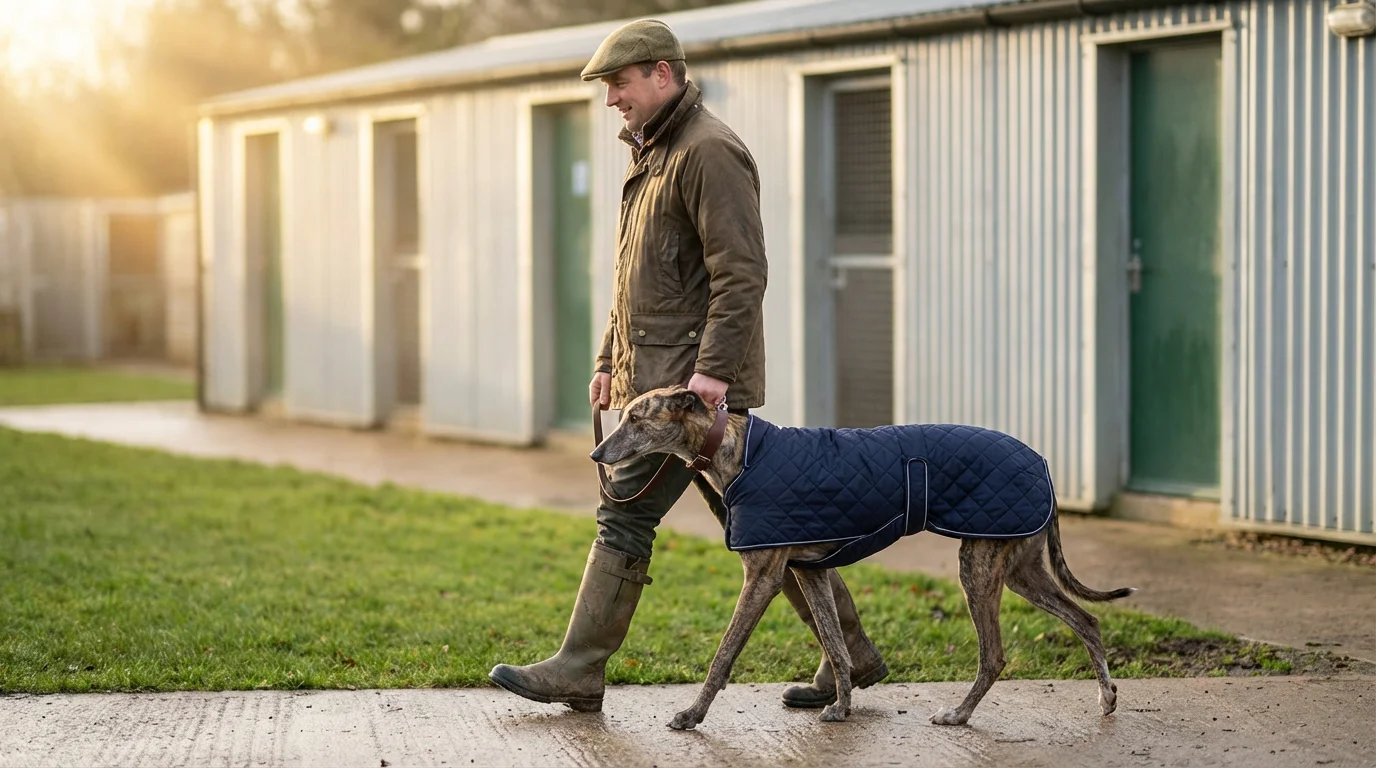
Trainers Are the Variable Most Punters Underweight
In horse racing, trainers are a central part of every punter’s analysis. In greyhound racing, they are an afterthought for most. The trainer’s name appears on the racecard, it gets mentioned in the commentary, and then it is ignored while the punter focuses on form figures, trap draws, and times. This is a mistake. The trainer is responsible for every aspect of the dog’s preparation — fitness, weight management, race scheduling, distance selection, and the tactical decision of when to run a dog hard and when to hold it back. That influence shapes results in ways the form figures do not always capture.
Greyhound trainers in the UK operate as small-scale professionals managing a kennel of dogs at one or two tracks. They know their dogs’ physical condition better than any racecard can convey, and their decisions about when and where to run a dog reflect private information about the dog’s readiness. A trainer entering a dog at a different distance, changing its usual track, or running it off a short break is making a statement — and that statement, read correctly, can give a punter insight that the rest of the market overlooks.
The data is there to support this analysis. Trainer strike rates, trainer-track specialisms, and trainer patterns around distance changes and grade adjustments are all measurable. The punters who incorporate trainer data into their form assessment are not working harder. They are working with a more complete picture.
Trainer Strike Rates and How to Find Them
A trainer’s strike rate is the percentage of their runners that win over a given period. It is the simplest measure of trainer quality and, despite its simplicity, one of the most useful. A trainer with a 25% strike rate across a hundred runners is producing winners at a meaningfully higher rate than a trainer at 12%. That gap reflects differences in dog quality, preparation standards, and race selection — all of which are the trainer’s responsibility.
Finding strike rate data has become significantly easier in recent years. Timeform publishes trainer statistics as part of its greyhound service. The GBGB’s results archive allows you to filter by trainer and calculate rates manually. Specialist greyhound data sites aggregate the numbers into searchable databases where you can look up any licensed trainer’s record by track, distance, grade, and time period. Some bookmakers also display trainer statistics alongside the racecard, though the depth of data varies by operator.
The important refinement is to look at trainer strike rates by track rather than overall. A trainer might have a 20% win rate across all tracks but a 30% rate at one specific stadium where they have a deep understanding of the track, strong relationships with the racing manager, and dogs well suited to the track’s characteristics. That 30% local rate is far more predictive for races at that track than the diluted overall figure. If you are specialising in one track, the local trainer strike rates are the numbers that matter.
Sample size caveats apply. A trainer with three wins from five runners has a 60% strike rate that means nothing statistically — the sample is too small to draw conclusions. You need at least thirty to fifty runners before strike rate data becomes reliable. For trainers with smaller strings who run infrequently, the numbers may never reach a useful threshold, and in those cases, qualitative observation — watching how their dogs are presented, noting how they perform relative to their grade — becomes the primary tool.
Strike rates over different time periods tell different stories. A trainer’s career rate shows long-term quality. Their rate over the last three months shows current form. If the three-month rate is significantly higher than the career rate, the kennel is in a hot spell — the dogs are fit, the preparation is working, and the trainer’s selections are landing. If the three-month rate has dropped below the career average, something may have changed: new dogs settling in, illness in the kennel, or simply a run of bad luck that has not yet corrected.
Trainer-Track Patterns and Specialisms
Most greyhound trainers operate primarily at one or two tracks, which creates natural specialisms. A trainer based near Romford who runs the majority of their dogs there will understand that track’s geometry, surface behaviour, and grading tendencies better than a visiting trainer who sends a dog across for a one-off entry. This home advantage is real and measurable — local trainers tend to produce higher strike rates at their home tracks than away trainers, all else being equal.
The specialism extends beyond simple familiarity. Trainers who work consistently at a particular stadium build relationships with the racing manager who controls grading decisions, kennel allocation, and race scheduling. They know which grades suit their dogs, which meeting nights tend to produce weaker or stronger fields, and how the track rides in different weather conditions. None of this information appears on a racecard, but all of it influences the likelihood of a dog being placed in a race it can win.
Some trainers develop specialisms in particular types of racing. One might be known for producing strong sprint dogs. Another might have a record of bringing young dogs through the puppy and novice grades into open competition. A third might specialise in staying events, placing dogs at distances that suit their stamina rather than their raw speed. These patterns are identifiable from the data: filter a trainer’s results by distance category and you will see where their strengths lie.
Trainer-track combination data is one of the most profitable angles in greyhound form. When a trainer with a 28% strike rate at a specific track enters a dog that also has strong recent form and a favourable trap draw, you have three independent positive factors converging on the same selection. Each factor alone has value. Combined, they produce a level of confidence that casual form reading cannot match.
Trainer Moves That Signal Intent
Trainers communicate through their decisions, and certain moves carry specific signals that attentive punters can read. These are not secret codes — they are logical actions that make sense when you understand the trainer’s objectives.
A distance change is one of the clearest signals. When a trainer moves a dog from 480 metres down to 270 metres, they are saying the dog has speed but cannot sustain it over four bends. They are placing it where its strength — early pace — becomes the dominant factor. When a dog is stepped up from 480 to 660 metres, the trainer believes it has stamina that is going untested at the shorter trip. In both cases, the trainer is optimising the dog’s chance of winning by matching it to a distance that suits its physical profile. If you agree with that assessment, the first run at the new distance often offers value because the market has not yet seen the dog perform there.
Running a dog off a short break after a period of rest is another signal. Trainers rest dogs for a reason — injury recovery, loss of form, or planned preparation for a specific target race. When the dog returns, the trainer has made a decision that it is ready. If the dog trials well before its return race (and trial results are sometimes available through the track or data services), the combination of a rested dog and a confident trainer entry is a positive indicator.
Grade drops combined with a trainer’s entry decision deserve particular attention. If a trainer’s dog drops from A3 to A5 and the trainer enters it at the first available opportunity at the new grade, they believe the dog can compete immediately. If the trainer waits two or three meetings before entering at the new grade, they may be using the gap for additional preparation — trials, fitness work, or weight adjustment — which suggests the drop was performance-related rather than just administrative.
Conversely, when a trainer withdraws a dog from a race close to the off — particularly at a track where the trainer is well established — it often signals a genuine concern about the dog’s condition. Last-minute withdrawals are not taken lightly because they disrupt the race and the trainer’s relationship with the racing manager. If a regular trainer pulls a dog late, something has changed between the morning declaration and the evening race, and the smart response for punters is to note the dog and treat its next entry with caution until it demonstrates fitness.
Follow the Handler, Not Just the Dog
The dog is what runs. The trainer is what decides when, where, and in what condition it runs. That distinction matters more than most punters allow for. A talented dog in the hands of a mediocre trainer will underperform its ability — wrong distances, poor race selection, suboptimal fitness preparation. A moderate dog in the hands of an excellent trainer will punch above its weight — placed in races it can win, prepared specifically for the conditions, entered when the grading and trap draw align.
Building trainer data into your form analysis does not require hours of additional work. It requires adding one column to your assessment: who trains this dog, and what is their recent record at this track? If the answer is a trainer on form at a track they know well, that is a tailwind for the selection. If the answer is a trainer in poor form or one making an unusual decision you cannot explain, that is a flag worth noting.
Over time, you will develop your own list of trainers whose runners consistently perform and trainers whose entries you treat with scepticism. That list is personal and track-specific — a trainer you trust at one stadium might have no record at another. The work of building it is the work of becoming a serious greyhound punter rather than a casual one. The dog’s name is on the racecard. The trainer’s name is right next to it. Read both.
Get more form analysis at greyhoundresultsyester.
Also explore our form guide.
