

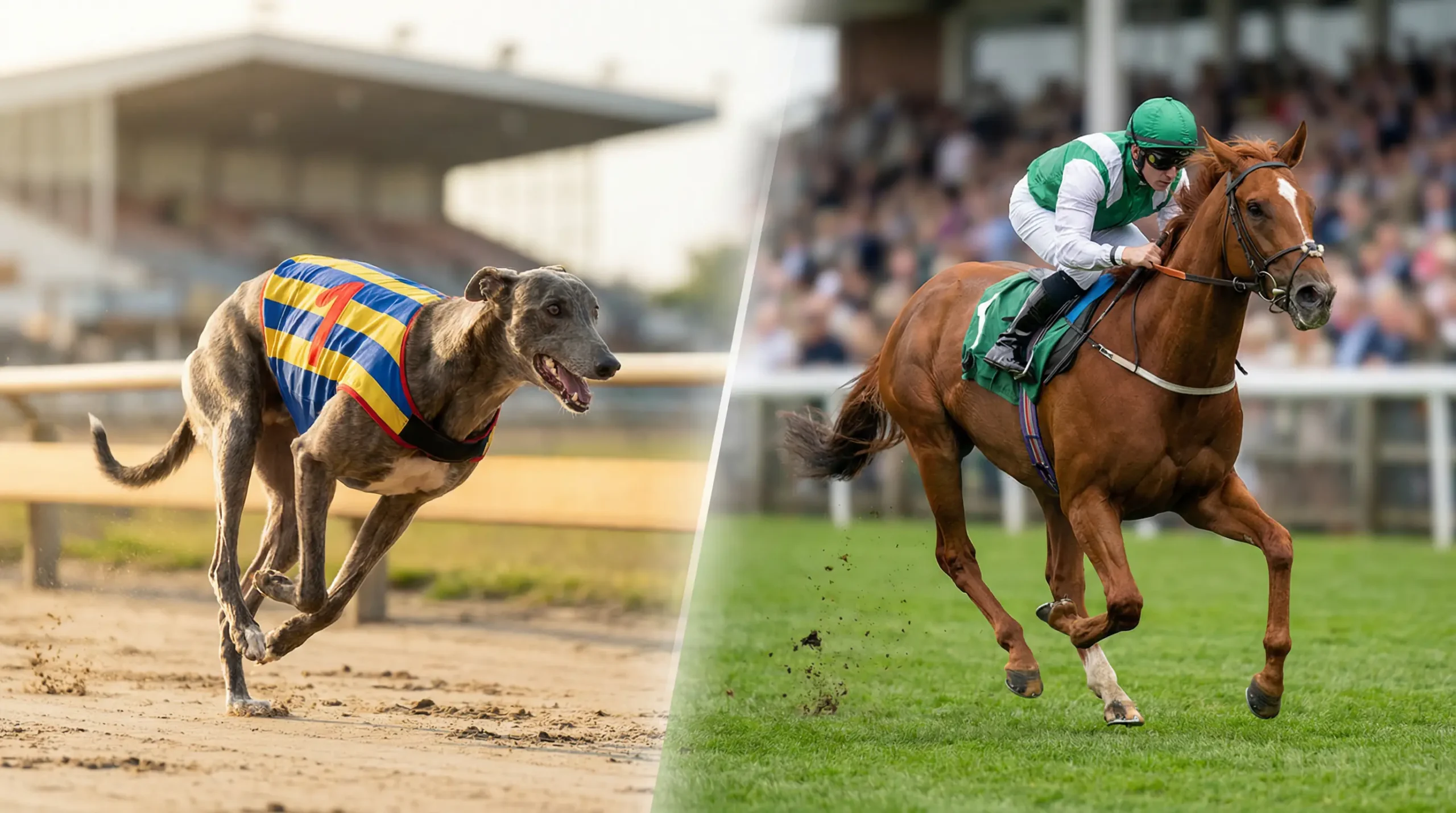
Same Sport, Different Animal — Literally
Punters who move between horse racing and greyhound racing often assume the skills transfer directly. They do — up to a point. Both sports involve reading form, assessing conditions, identifying value in the odds, and managing a staking plan. The analytical framework is broadly the same. But the mechanics of the two sports are different enough that a profitable horse racing punter can lose money at the dogs through habits and assumptions that do not translate.
The differences are not cosmetic. They are structural: the number of runners, the role of the jockey, the speed of the races, the market depth, the each way terms, and the frequency of meetings. Each of these differences changes how you should approach selection, staking, and market interaction. Understanding where greyhound betting diverges from horse racing — and where it demands a genuinely different approach — is the first step for any horse racing punter looking to expand into the dogs, and for any greyhound punter who wants to understand why their sport behaves the way it does.
Structural Differences: Field Size, Distances, Jockey Factor
The most fundamental difference is field size. A greyhound race has six runners. A horse race can have anywhere from four to forty, with most flat handicaps featuring fields of ten to sixteen. That arithmetic changes everything. In a six-runner race, any dog has a baseline 16.7% chance of winning before form is considered. In a twelve-runner horse race, that baseline drops to 8.3%. The smaller field means greyhound betting operates in a tighter probability space — the range of possible outcomes is smaller, the market prices are compressed, and the information asymmetry between punters and bookmakers is narrower.
There is no jockey in greyhound racing. This is not a minor detail — it removes an entire variable that horse racing punters spend significant time analysing. In horse racing, the jockey makes tactical decisions during the race: when to push, when to hold, which route to take, how to respond to the pace. In greyhound racing, the dog runs on instinct and training. There are no in-race decisions. The dog breaks from the trap, follows the lure, and runs its natural line. This makes greyhound form more mechanically predictable — the dog will run essentially the same race every time, barring interference — but it also means that when things go wrong, there is no jockey to adjust.
Race duration differs dramatically. A standard horse race lasts between one and four minutes depending on the distance. A standard greyhound race over 480 metres lasts about 29 seconds. The compressed timeframe means less scope for tactical change during the race, less time for early trouble to be corrected, and more reliance on the first few seconds determining the final outcome.
Distances in greyhound racing span a much narrower range than in horse racing. From the shortest sprint to the longest marathon, the entire spectrum covers roughly 210 to over 1,000 metres. Horse racing distances range from five furlongs to over four miles. The narrower range means greyhound physical profiles are less varied, but the differences that exist — between a sprint specialist and a stayer — are proportionally just as significant for betting purposes.
Track variety is another distinction. Horse racing in the UK features dozens of different courses with unique configurations — left-handed, right-handed, flat, undulating, sharp, galloping. Greyhound tracks are standardised oval circuits with minor geometric variations. This standardisation makes cross-track form comparison easier in greyhound racing, though it does not eliminate the need for track-specific knowledge about bend tightness and trap bias.
Betting Market Differences: Odds, Each Way Terms, Liquidity
Greyhound betting markets are structurally different from horse racing markets in ways that directly affect your approach. The most visible difference is price range. In a six-dog race, the favourite is typically priced between even money and 5/2, while the longest shot in the field might be 8/1 or 10/1. In a twelve-runner horse race, the favourite might be 3/1 while the outsiders drift to 33/1. This compressed range in greyhound betting means potential returns on single win bets are smaller, and the market is less generous on long shots.
Each way terms differ significantly. In greyhound racing, the standard is two places at one quarter the odds for a six-dog field. In horse racing, races with eight or more runners typically pay three places at one fifth the odds, and some bookmakers offer enhanced terms for larger fields. The greyhound each way bet is a tighter proposition — fewer place positions and a smaller fraction of the odds. This makes each way betting less attractive at the dogs than at the horses, particularly at shorter prices where the place return barely covers the lost win stake.
Market liquidity is lower in greyhound racing than in horse racing. The total amount of money bet on an individual greyhound race is a fraction of what flows through a decent horse racing handicap. This affects exchange users most directly — the Betfair greyhound markets are thinner, with wider spreads between back and lay prices and less money available to match at quoted odds. For bookmaker punters, the practical effect is subtler: greyhound odds can move sharply on relatively small amounts of money, which means early prices are more volatile and late market moves are harder to interpret.
Odds movement patterns differ between the two sports. In horse racing, significant early market moves often indicate informed money — connections, stable staff, or professional punters acting on private information. In greyhound racing, early price moves are less likely to carry the same weight of private information, because the sport has fewer layers of inside knowledge. Trainer and kennel information matters, but the absence of a jockey variable and the simpler race dynamics mean there is less private information to trade on. Market moves in greyhound racing are more often driven by public form assessment than by inside knowledge.
Forecast and tricast betting is proportionally more important in greyhound racing. The six-dog field makes these bet types more accessible than their horse racing equivalents, and the CSF and CT dividends form a larger part of the overall greyhound betting economy. A punter who ignores forecast and tricast markets at the dogs is leaving out a significant portion of the available betting opportunities.
Which Suits Your Betting Style?
The choice between greyhound and horse racing betting — or the decision to participate in both — depends on what kind of punter you are. If you value deep form analysis with multiple data layers (jockey, trainer, course, distance, going, draw, breeding), horse racing offers a richer analytical canvas. If you prefer a more mechanical, data-driven approach where fewer variables need to be assessed per race, greyhound racing’s stripped-down structure is an advantage.
Greyhound racing suits punters who value volume and frequency. With hundreds of races available daily and meetings running from morning to night, the dogs provide more opportunities per day than any other racing sport. If you are the type of punter who wants to bet regularly and builds profitability through a high volume of small-edge bets, the greyhound calendar accommodates that approach better than horse racing, where the quality meetings are concentrated on certain days.
Horse racing suits punters who prefer event-based betting — studying a single big-field handicap for hours, building a detailed picture of every runner, and placing one or two carefully considered bets. The depth of information available for horse racing, combined with the larger fields and wider price ranges, creates a more rewarding environment for that style of deep analysis.
Many profitable punters do both, applying different strategies to each sport. The discipline of form reading and value identification is universal. The specific tactics — trap bias at the dogs, draw bias on the flat, jockey booking patterns, trainer statistics — are sport-specific but not mutually exclusive. The punter who can switch between the two without carrying habits from one into the other is well positioned to exploit opportunities wherever they arise.
The Dogs Aren’t a Lesser Version of the Horses
Greyhound racing is sometimes treated as a secondary betting medium — something punters turn to when the horse racing card is quiet or when they want a quick bet between football matches. That framing undersells the sport and the betting opportunities it provides. The dogs are not a lesser version of the horses. They are a different product with different characteristics, different market dynamics, and different edges available to those who study them seriously.
The six-dog field creates a probability environment that rewards consistent, disciplined betting over long periods. The absence of a jockey makes form more mechanically repeatable. The frequency of racing provides a larger sample size for testing and refining strategies. The lower media profile means less public analysis, which in turn means more room for a prepared punter to hold an information advantage over the general market.
Whether you bet on greyhounds exclusively, on horses exclusively, or on both, the principle is the same: the sport rewards those who understand its specific mechanics and exploit the edges those mechanics create. The dogs have their own logic. Learn it on its own terms, and the returns will follow.
Find more betting guides at greyhoundresultsyester.
Also explore our bet types.
