

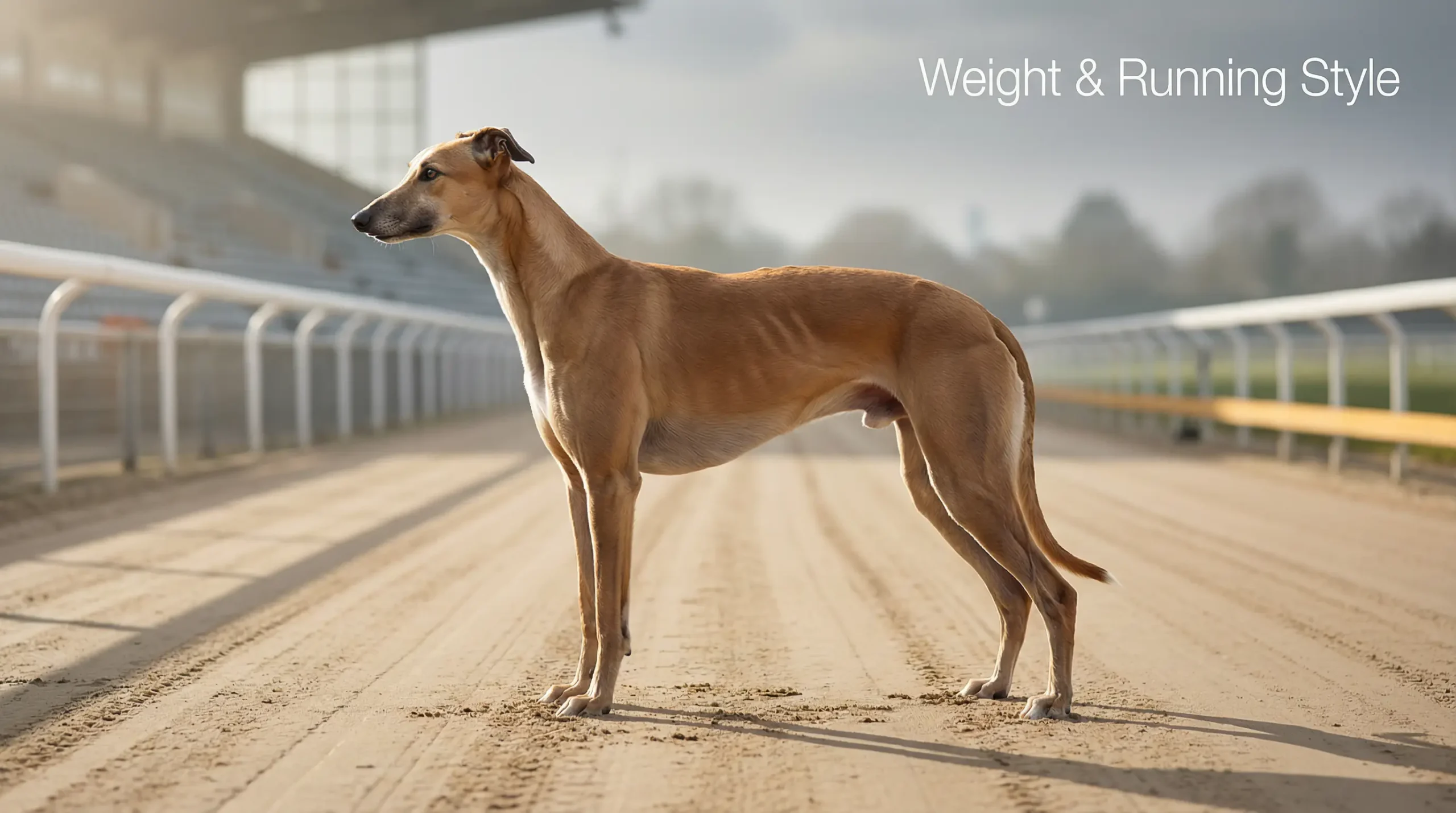
Build Matters — More Than Most Punters Think
Most greyhound punters check times, trap draws, and recent finishing positions before placing a bet. Relatively few pay attention to the weight printed on the racecard or consider how a dog’s physical build relates to its racing characteristics. That is a missed opportunity. A greyhound’s weight and body composition influence its speed, stamina, acceleration, and ability to handle bends — all of which directly affect race outcomes and, by extension, betting value.
Weight alone is not a predictor of ability. A heavier dog is not automatically slower, and a lighter dog is not automatically faster. What weight tells you is something about the type of athlete you are looking at: whether the dog is built for explosive sprint speed or sustained effort over longer trips, whether it is likely to be strong through the bends or quick out of the traps, and whether changes in weight between races might signal a change in condition or fitness. Combined with running style — the observable pattern of how a dog races — weight data provides a physical profile that deepens your understanding beyond what the form figures offer.
The punters who incorporate weight and running style into their analysis are working with a fuller picture of each dog. That fuller picture does not guarantee winners, but it reduces the frequency of surprises — and in a sport where surprise results cost money, that reduction has tangible value.
Greyhound Weight: What the Scales Tell You
Every greyhound is weighed before racing, and the weight is published on the racecard. Racing weights for UK greyhounds typically range from around 25 kilograms for smaller bitches to 36 kilograms or more for large dogs, though most fall somewhere in the 28 to 34 kilogram range. The weight figure on the racecard is the dog’s weight at the track on race day — not its training weight, not its ideal weight, but its actual measured weight on the evening it runs.
The absolute weight matters less than the weight trend. A dog that consistently races at 31 kilograms has established a racing weight — the weight at which it performs at its best. If that dog appears on the racecard at 32.5 kilograms, the 1.5-kilogram increase is a signal. It might indicate the dog has been rested and is carrying extra condition. It might suggest a lack of fitness. It might mean nothing at all if the dog is still within its normal range. But the deviation from the established pattern is worth noting, because changes in racing weight often precede changes in performance.
Weight loss can be equally informative. A dog that drops a kilogram from its usual racing weight might be at peak fitness — trained hard and ready to run fast. Or it might be underweight due to illness, stress, or overracing. The context matters. A dog returning from a short break at a slightly lower weight after a preparation period is a different proposition from a dog that has raced every week for six weeks and is visibly losing condition. The form card does not make this distinction, but a punter who tracks weights across runs can recognise the pattern.
As a general rule, lighter dogs tend to be quicker out of the traps and more agile through the early bends. They accelerate faster but may lack the raw power to sustain top speed over longer distances. Heavier dogs tend to be stronger in the second half of the race — they maintain pace through the bends and often finish more powerfully over middle and stayer distances. These are tendencies, not absolutes, but they are consistent enough to inform assessments of how a dog will handle a particular distance or trap draw.
The most practical use of weight data is comparative rather than absolute. Within a single race, checking how each dog’s current weight compares to its recent average tells you which runners are at their optimum and which might be above or below. A dog at its established racing weight is the baseline. A dog noticeably above or below it is the variable that warrants further investigation.
Running Styles: Railers, Wide Runners, Front-Runners
Running style describes the pattern a dog follows during a race — where it positions itself in the field, how it navigates the bends, and where its strongest phases of running occur. While every dog is different, the major running styles fall into recognisable categories that have direct implications for trap draw, race dynamics, and betting assessment.
Railers are dogs that hug the inside rail around the bends. They take the shortest route around the track, which means they cover less ground than dogs that run wider. A committed railer drawn in trap one has the optimal position: it is already on the rail and can maintain that line from the traps through the first bend without needing to cross in front of other dogs. A railer drawn in trap six faces a problem — it needs to work across the field to reach the rail, and that transition costs time and invites interference. Railers from low draws are the most straightforward assessments in greyhound form. Railers from high draws are risky propositions unless the dog has exceptional early pace to cross the field before the first bend.
Wide runners take a line outside the main field, typically running two or three paths off the rail through the bends. They sacrifice the ground advantage of the rail in exchange for a clearer run — they avoid the congestion on the inside, reduce the risk of interference, and maintain a smoother stride pattern. Wide runners are less affected by trap draw than railers because their racing line does not depend on being close to the rail from the start. A wide runner from trap five or six is already on the outside and can hold its natural line without adjustment. From trap one, a wide runner may waste energy or lose position working away from the rail to find its preferred route.
Front-runners are dogs whose primary asset is early pace. They leave the traps quickly, lead into the first bend, and aim to hold that lead for the entire race. A front-runner that establishes a clear lead is difficult to pass — in greyhound racing, unlike horse racing, there is no tactical riding, no jockey to time a challenge, and the dog that leads into the final straight wins more often than not. The vulnerability of front-runners is when they fail to lead. A front-runner that is outpaced early and finds itself in second or third position often does not have the finishing speed to recover, because its entire racing pattern depends on dictating from the front.
Closers are the opposite: dogs that sit behind the early pace and produce their best running in the final two hundred metres. They are less common in greyhound racing than in horse racing because the shorter race distances and the absence of a jockey’s tactical input limit the scope for a sustained closing run. But they exist, and when a closer encounters a race where the front-runners are unusually tightly matched and interfere with each other, the closer inherits the lead without having to produce anything exceptional. Identifying closers and matching them to races where the front-running dynamics are likely to be contested is a small but repeatable edge.
How Weight and Style Interact With Trap and Distance
Weight and running style are not isolated variables. They interact with each other and with the race conditions to create a physical profile for each dog that maps onto specific trap draws and distances. Understanding these interactions allows you to predict which dogs are well suited to the race configuration and which are compromised.
A light, fast-starting railer drawn in trap one over a sprint distance is the ideal combination. The dog has the speed to exit the trap first, the agility to hold the rail through the bend, and the draw that puts it in the position its running style requires. That same dog drawn in trap five over a stayer distance is a poor fit — the wide draw forces it to cross the field, the longer trip exposes its lack of stamina, and the race configuration undermines every advantage the dog possesses.
A heavier, stronger dog with a wide-running style drawn in trap six over a middle distance is a solid match. The outside draw suits its natural line, the dog’s power helps it maintain speed through the bends despite covering more ground, and the middle distance gives it enough race to deploy its strength without being asked to sustain it for an uncomfortably long trip. The same dog drawn in trap one faces a dilemma: rail tight against its instincts, or waste the first bend working out to its preferred wider line.
Weight changes can also interact with distance. A dog that has put on a kilogram since its last run may lose a fraction of its early speed but gain endurance, which makes it better suited to a step up in distance. Conversely, a dog that has shed weight may be sharper over shorter trips but more vulnerable in the closing stages of a longer race. These are subtle shifts, not dramatic transformations, but they are the kind of marginal adjustments that create the price discrepancies value bettors exploit.
The practical discipline is to consider weight and style as part of the race assessment, not as standalone factors. When you study a racecard, note each dog’s weight relative to its average, identify its running style from the form comments and replays, and then assess whether the trap draw and distance suit that physical profile. The dogs whose profile matches the race configuration are your primary candidates. The dogs whose profile conflicts with the configuration are the ones the market is most likely to misprice — in both directions.
Know the Dog, Not Just the Data
Form figures, times, and grades are abstractions. They compress a living animal into a line of text. Weight and running style bring the dog back into the analysis as a physical entity with characteristics that influence how it races. A dog is not a set of numbers — it is an athlete with a body type, a racing temperament, and a preferred way of running. The punter who understands these physical characteristics, and accounts for them when assessing a race, is working with a more complete model than the punter who sees only the digits on the form card.
Track weight trends, note running styles from replays and form comments, and use both to evaluate whether a dog’s race configuration is favourable or hostile. This layer of analysis does not replace the fundamentals of form study. It adds texture and specificity to them — and in a market where most punters never look beyond the headline figures, that texture translates directly into betting value.
Get more form analysis at greyhoundresultsyester.
Also read our greyhound sectional times.
