

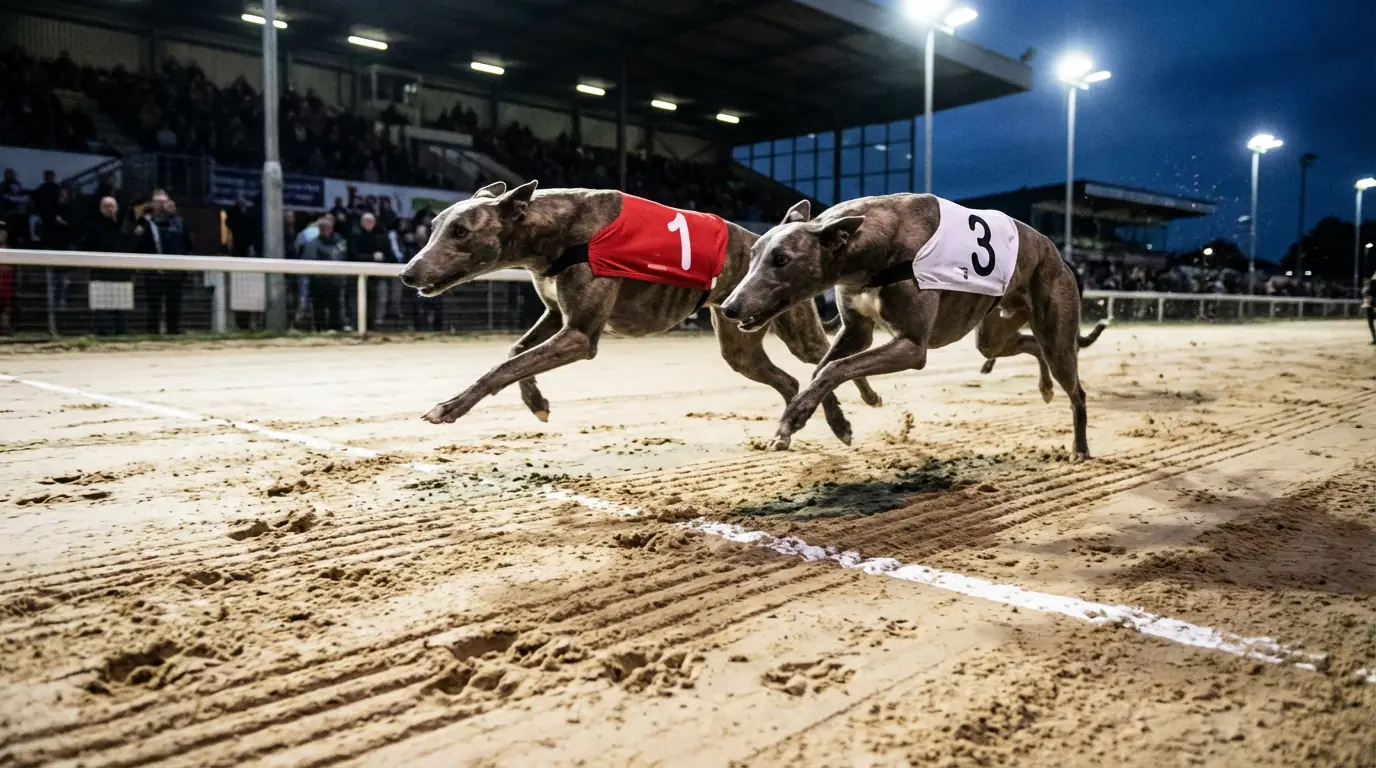
Forecast Betting: Picking the Top Two in Order
A forecast bet asks you to do something deceptively hard — name not just the winner, but the runner-up too. It is one of the most popular bet types in UK greyhound racing, and for good reason. The payouts can be substantial, the six-dog field makes it more accessible than the equivalent in horse racing, and it rewards punters who genuinely understand the form of multiple dogs in a race rather than just the one they fancy to win. In UK greyhound racing, fields are limited to six runners (GBGB).
The concept is straightforward: you select two dogs and predict which will finish first and which will finish second. If you get both right, you collect a dividend that is almost always significantly higher than a simple win bet. The difficulty, of course, is that predicting the exact order of two finishers is harder than it sounds — even in a six-runner field, there are 30 possible first-and-second combinations, and only one of them pays out on a straight forecast.
Forecast betting comes in three main forms: straight, reverse, and combination. Each represents a different balance between cost, coverage, and potential return. Understanding the mechanics of all three allows you to choose the right structure for each race, rather than defaulting to the same approach regardless of the field.
Straight Forecast: First and Second in Exact Order
The straight forecast is the purest form — highest risk, highest reward. You name one dog to finish first and another to finish second, and both must arrive in exactly that order for the bet to win. There is no flexibility and no partial payout. If your first selection wins but your second selection finishes third, the bet loses. If both dogs fill the top two places but in the wrong order, the bet still loses.
Payouts on straight forecasts in UK greyhound racing are calculated using the Computer Straight Forecast, commonly abbreviated as CSF. This is a formula-based dividend that the industry calculates after the race, based on the starting prices of the first and second dogs. It is not a fixed price agreed at the time of the bet — it is determined by market conditions at the off. This means the exact payout is unknown until the race is over, which is different from a standard win bet where you can lock in a price.
In practice, CSF dividends in greyhound racing vary enormously. A forecast involving two short-priced dogs might return relatively modest amounts — perhaps five to fifteen times the stake. A forecast featuring an outsider in either position can push returns into the hundreds. The six-dog field plays a role here: because there are fewer runners than in horse racing, the base probability of any two dogs finishing first and second is higher, which keeps forecast dividends lower than their equivalents in larger fields. That said, a well-judged straight forecast at the dogs routinely returns more in a single bet than most win bets return in a week.
The skill in straight forecasting lies not just in identifying the winner, but in having a genuine opinion about the runner-up. This is where most punters fall short. They know which dog they like to win but have no considered view on which dog will beat the rest of the field for second. If you find yourself picking the second dog at random or defaulting to the second favourite, you are not forecast betting — you are guessing with extra steps. The straight forecast is only worth the risk when you have a clear, form-based reason to believe both selections will finish in the positions you have assigned them.
One common scenario where straight forecasts work particularly well is when a strong favourite is paired with a dog that has consistent place form. If the favourite has won three of its last four and a second dog has finished in the top two in four of its last five, the combination has structural logic behind it. The favourite provides confidence in the first position, and the consistent placer provides evidence for the second. Neither selection is a shot in the dark.
Reverse Forecast: Either Order, Double the Stake
Cover both permutations and halve the anxiety — at the cost of doubling your stake. A reverse forecast selects the same two dogs as a straight forecast, but it does not require you to specify which finishes first and which finishes second. As long as your two selections fill the top two places in either order, the bet wins.
Mechanically, a reverse forecast is simply two straight forecasts combined into one bet. You are placing Dog A first and Dog B second as one line, and Dog B first and Dog A second as the other. Because there are two lines, the stake is doubled. If you place a one-pound reverse forecast, you are spending two pounds. The payout is the CSF dividend for whichever permutation actually occurs — you do not receive both dividends, only the one that matches the result.
The reverse forecast makes sense when you are confident that two dogs will dominate a race but genuinely uncertain about which one will beat the other. This happens more often than you might think, particularly in evenly graded races where two dogs have similar form and comparable early pace. In those situations, the order of finish might come down to the trap draw on the day, a slight bump on the bend, or which dog gets the cleaner run. Trying to separate them is a coin flip, and the reverse forecast removes the need to call it.
The trade-off is cost versus certainty. A straight forecast at one pound costs one pound and pays the full CSF if correct. A reverse forecast at one pound per line costs two pounds and pays the same CSF. If the CSF dividend is large enough, the doubled stake is trivial. If the dividend is modest — say, a forecast involving two short-priced dogs — the doubled stake eats into the return more noticeably. The rule of thumb is that reverse forecasts offer better value when at least one of the two dogs is at longer odds, because the potential CSF dividend justifies the additional outlay.
Combination Forecast: Multiple Dogs, Multiple Permutations
More dogs in the mix, more lines covered — the cost climbs fast. A combination forecast allows you to select three or more dogs and cover every possible first-and-second permutation between them. It is the broadest form of forecast betting, and it is designed for races where you believe the top two will come from a defined group but cannot narrow it down to just two individuals.
The mathematics are straightforward but worth understanding. With three dogs selected, there are six possible first-and-second permutations: A-B, B-A, A-C, C-A, B-C, and B-C reversed. That means a three-dog combination forecast costs six times your unit stake. With four dogs, the permutations jump to twelve. With five dogs, twenty. In a six-dog greyhound race, selecting all six dogs would produce thirty permutations — at which point you are covering every possible forecast outcome and guaranteeing yourself a return, but almost certainly at a loss after the stake outlay.
The practical sweet spot for combination forecasts is three dogs, occasionally four. At three selections in a six-runner field, you are covering six of the thirty possible outcomes — a 20% coverage rate — for six times the unit stake. If any of those six permutations lands, the CSF dividend needs to be at least six times your unit stake to break even, and ideally much higher to produce a meaningful profit. This is achievable when at least one of the three dogs is at mid-range to longer odds, because the CSF dividend scales with price.
Four-dog combinations cost twelve units per line and require a larger dividend to justify the outlay. They work best in genuinely open races — events where the form points to four competitive dogs and two weaker ones, and you are confident the weaker pair will not fill the top two places. If you can eliminate two dogs from contention with reasonable confidence, a four-dog combination forecast covers every remaining permutation and gives you a strong structural position.
The mistake most punters make with combination forecasts is selecting too many dogs out of uncertainty rather than conviction. If you are including a dog because you are not sure whether to leave it out, the combination is costing you money for coverage you do not need. Every additional selection doubles or triples the stake. Be ruthless about which dogs genuinely belong in the group and which are padding.
When Forecast Bets Offer Value
Forecast value typically exists in races where the favourite is strong but the second place is wide open. This is the ideal forecast shape: you have high confidence in one dog winning, and a reasonable spread of candidates for the runner-up spot. The favourite anchors your forecast, and the open nature of the second position means that at least one plausible runner-up will be at a long enough price to generate a worthwhile CSF dividend.
The opposite scenario — an open race where any dog could win — is less suited to forecast betting. Without a reliable anchor for first place, your forecast becomes speculative on both positions, and the probability of landing the exact combination drops sharply. In those races, a simple win or each-way bet on your top pick is usually a more efficient use of your stake.
Another useful indicator is the form book’s place data. If a dog has finished second in three of its last five races, it is demonstrably consistent in the runner-up role. Pairing it with a strong favourite as a straight forecast is a high-conviction play. The market rarely prices this kind of consistency fully into the CSF calculation, because the CSF formula relies on starting prices rather than place form history. That disconnect between form evidence and mathematical dividend is where forecast value tends to live.
Forecasts Reward Attention to the Full Field
The punter who knows five dogs in a race, not just one, is the one forecast betting was built for. A win bet requires you to identify the best dog. A forecast requires you to understand the hierarchy of the entire field — who wins, who fills the places, and who can be safely dismissed. That deeper level of analysis is more work, but it unlocks a bet type that consistently produces better returns per successful selection than simple win betting.
The six-dog field is what makes greyhound forecast betting uniquely appealing. In horse racing, a twelve-runner handicap has 132 possible forecast combinations, and the probability of landing any specific one is slim. In greyhound racing, six dogs produce thirty combinations. The task is still difficult, but it is not astronomical — a punter with genuine knowledge of the race can realistically narrow the field to two or three plausible forecasts, and from there the odds are workable.
Whether you choose straight, reverse, or combination forecasts depends on the race and your level of conviction. Start with the race shape. Identify the likely winner. Then look at the rest of the field and ask yourself an honest question: do you actually know who is finishing second? If you do, go straight. If you know the top two but not the order, go reverse. If you know the group but not the pair, go combination. The structure of the bet should follow the structure of your analysis, not the other way around.
Find more bet type guides at greyhoundresultsyester.
Also read our tricast bet on greyhounds.
