

The Regulator Behind Every Licensed Race
Every greyhound race you bet on at a licensed UK track runs under the authority of the Greyhound Board of Great Britain. The GBGB is the governing and regulatory body for the sport in England, Scotland, and Wales, responsible for setting the rules that determine how races are run, how dogs are treated, and how the competitive integrity of the sport is maintained. If you have ever placed a bet on a UK greyhound race through a licensed bookmaker, the GBGB is the organisation that ensures the race you are betting on is conducted to a consistent, regulated standard.
For most punters, the GBGB operates invisibly. Its name appears on racecards, its logo is displayed at track entrances, and its rules govern everything from trap draw procedures to drug testing protocols. But unless something goes wrong — a welfare scandal, a doping positive, a disputed result — the average punter never thinks about the body that makes the sport function. That invisibility is, in a sense, a sign that the system is working. The regulation exists so that punters can focus on the racing itself, confident that the framework underneath it is sound.
Understanding what the GBGB does and why it exists is not essential for placing a bet, but it is useful for understanding the sport you are betting on. It also helps you distinguish between licensed GBGB racing — where standards are enforced and results are reliable — and independent or unregulated meetings, which operate outside the GBGB’s jurisdiction and carry a different risk profile for punters.
What the Greyhound Board of Great Britain Does
The GBGB’s responsibilities cover the full spectrum of the sport. At the broadest level, it sets and enforces the Rules of Racing — the regulatory framework that governs every aspect of a licensed greyhound meeting, from the registration of dogs and trainers to the conduct of races and the resolution of disputes.
Registration is the foundation. Every greyhound that races at a GBGB-licensed track must be registered with the Board. Registration involves identity verification — each dog carries a unique ear brand and is microchipped — which ensures that the dog on the track is the dog listed on the racecard. This prevents substitution, misidentification, and fraud. The registration system also tracks each dog’s racing history, ownership, and any disciplinary actions, creating a permanent record that follows the dog throughout its career.
Trainers and racing staff are also licensed by the GBGB. A trainer must hold a valid licence to operate at a GBGB track, and obtaining that licence involves meeting standards for kennel facilities, dog welfare, and professional competence. Licensed trainers are subject to random kennel inspections, drug testing of their dogs, and disciplinary proceedings if they breach the rules. This licensing framework is what separates the professional, regulated sport from informal or unregulated racing.
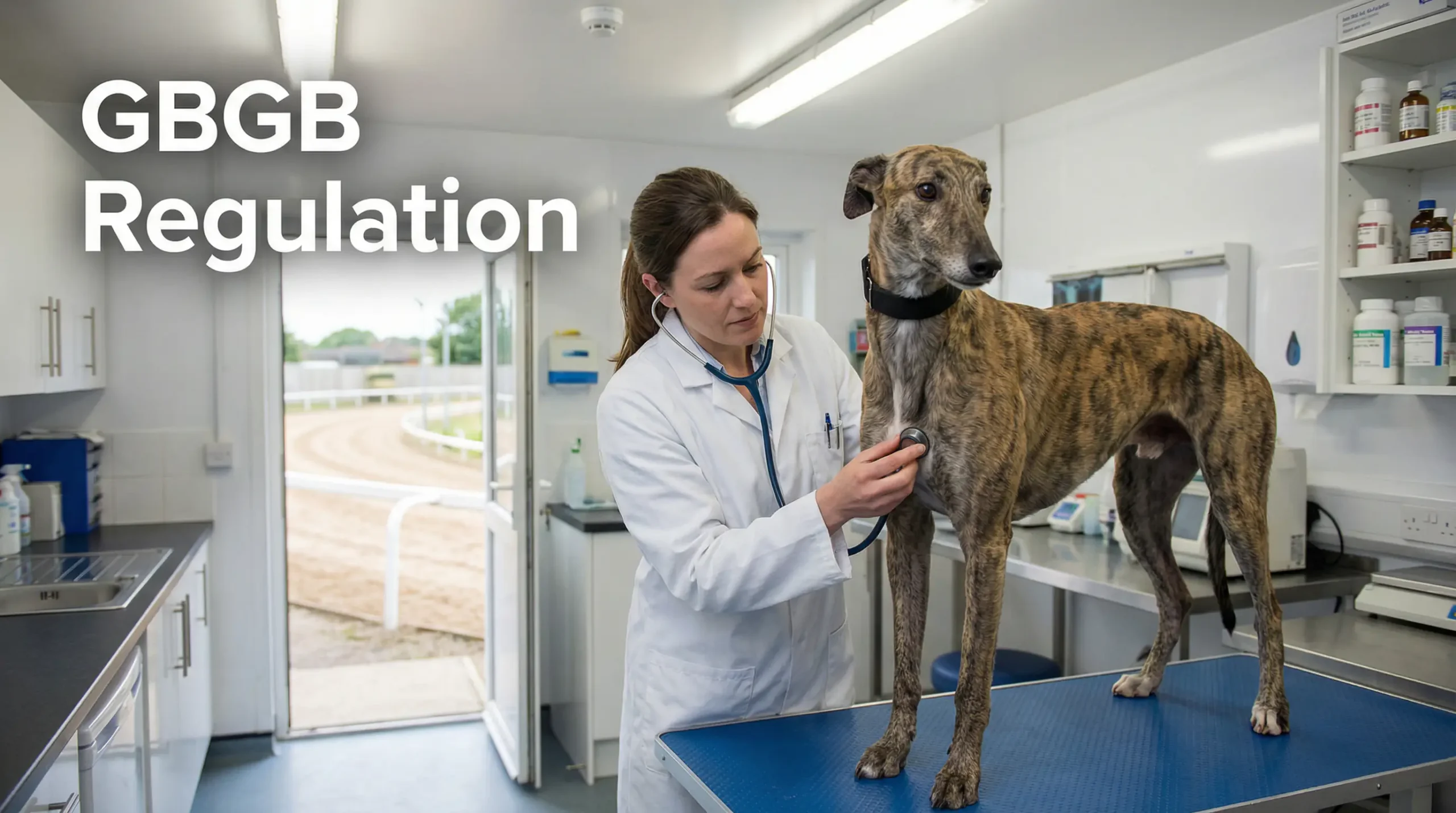
On race day, the GBGB’s regulatory presence takes several forms. Stipendiary stewards attend meetings to oversee the running of each race, adjudicate on incidents (bumping, interference, false starts), and ensure compliance with the rules. Veterinary officers inspect dogs before and after racing, checking for signs of injury, illness, or prohibited substances. The drug testing programme operates on a random and targeted basis, with samples taken at meetings across the country and analysed by accredited laboratories.
The GBGB also manages the grading system at each track — or more precisely, it sets the framework within which individual tracks operate their grading. The racing manager at each stadium applies the grading rules to their own pool of dogs, but those rules are established by the GBGB to ensure consistency across the licensed circuit. This means that while the specific grade a dog holds is track-specific, the principles governing how grades are assigned and changed are national standards.
Track Licensing and Welfare Standards
A track must hold a GBGB licence to operate as a regulated greyhound stadium. The licensing process requires the track to meet standards for facility quality, safety, veterinary provision, and racing operations. Licensed tracks are subject to regular inspections, and the licence can be revoked or suspended if standards are not maintained.
Welfare is the area where the GBGB has invested most heavily in recent years, in response to public concern and political pressure around the treatment of racing greyhounds. The Board enforces minimum welfare standards across all licensed tracks, covering kennel conditions, exercise requirements, injury management, and the retirement and rehoming of dogs when their racing careers end.
Injury reporting is mandatory at GBGB tracks. Every injury sustained by a dog during racing or trialling must be recorded and reported, and serious injuries are subject to veterinary review. This data is compiled nationally and published in the GBGB’s annual welfare report, which provides transparency on injury rates, the most common injury types, and the measures being taken to reduce them. Track surfaces, trap mechanisms, and bend geometry are all subject to safety assessments informed by this injury data.
The rehoming of retired greyhounds is a significant area of GBGB activity. The Board works with rehoming charities and maintains a fund to support the transition of racing greyhounds into domestic life after their careers end. Trainers are required to notify the GBGB when a dog leaves their care, and the Board tracks the destination of retired dogs to ensure they are rehomed, retained, or surrendered to an approved charity rather than abandoned or destroyed.
For punters, the welfare standards enforced by the GBGB are relevant because they underpin the sport’s public legitimacy and, by extension, its continued operation. A sport with poor welfare standards faces political and public opposition that threatens its survival. The GBGB’s welfare framework is partly a moral commitment and partly a practical necessity — maintaining the conditions under which racing can continue, tracks can hold licences, and bookmakers can offer markets.
Why GBGB Matters to Punters
The GBGB’s regulatory framework creates the conditions that make greyhound betting viable as a serious activity. Without regulation, you would have no guarantee that the dogs are who the racecard says they are, no assurance that the races are conducted fairly, no drug testing to prevent chemical manipulation of results, and no consistent grading system to structure competitive fields. Every one of these elements is a precondition for informed betting, and every one is maintained by the GBGB.
The distinction between GBGB-licensed and unlicensed racing is particularly important. Independent or “flapping” tracks operate outside the GBGB’s jurisdiction. They are not subject to the same registration, testing, welfare, or grading standards. Betting on independent meetings carries a higher risk of unreliable form data, inconsistent race conditions, and outcomes that are not governed by the same integrity framework. Most licensed UK bookmakers restrict their greyhound markets to GBGB-regulated meetings for exactly this reason — the regulatory framework is what makes the product bettable at scale.
The GBGB’s results and data infrastructure also benefits punters directly. The Board’s results archive is one of the primary sources for historical race data, form figures, and track-level statistics. This data feeds into the form databases and statistics services that punters use daily. Without the GBGB’s systematic collection and publication of racing data, the information ecosystem that supports greyhound form analysis would be significantly weaker.
Disciplinary decisions made by the GBGB can also carry betting implications. If a trainer is suspended or fined for a rule breach, their dogs may be temporarily unavailable for selection or may be transferred to another trainer, which disrupts form continuity. If a track’s licence is under review, meetings may be rescheduled or relocated. Staying aware of GBGB announcements — which are published on their website — gives punters a heads-up on developments that could affect upcoming meetings.
Regulation Is What Keeps Greyhound Racing Bettable
Greyhound racing in the UK works as a betting product because it is regulated. The rules are known, the standards are enforced, and the data is published. A punter studying a racecard at a GBGB-licensed track can be confident that the dogs are correctly identified, the grading reflects recent performance, the track meets safety standards, and the results are recorded accurately. None of those things can be taken for granted without a regulatory body maintaining them.
The GBGB is not perfect, and the sport it governs faces genuine challenges — welfare concerns, declining track numbers, and the economic pressures of operating small sporting venues in a competitive leisure market. But the regulatory framework itself is the structural foundation on which the entire greyhound betting economy is built. Without it, the form means less, the results are less trustworthy, and the edge available to an informed punter is correspondingly smaller.
For punters, the GBGB is the reason you can open a racecard, study the form, and place a bet with confidence that the data you are working from reflects a genuine, regulated competition. That confidence is the baseline from which all greyhound analysis starts.
Stay informed at greyhoundresultsyester.
Also read our legal information.
