
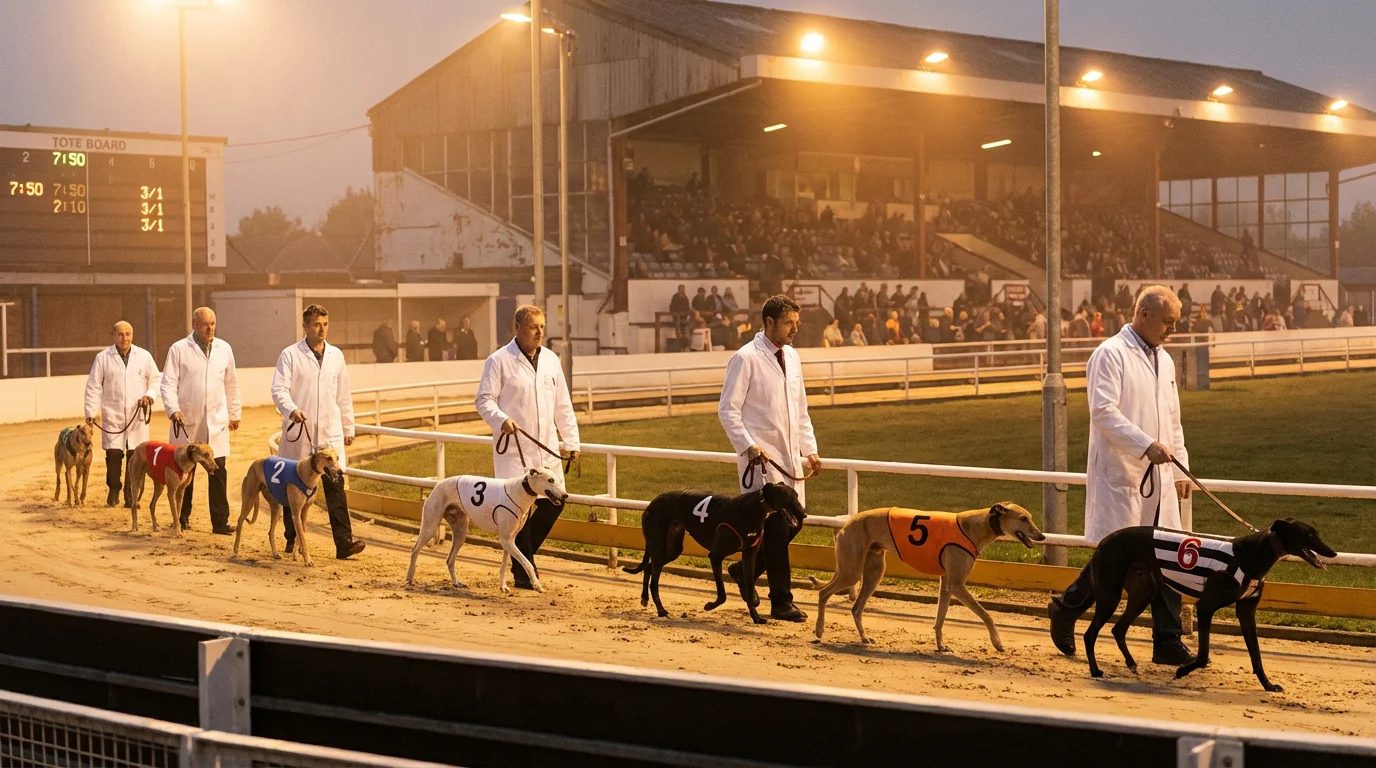
The Grading System Is the Hidden Architecture of UK Dog Racing
Grades are not just labels — they are the mechanism that keeps races competitive and betting interesting. Every licensed greyhound track in the UK operates a grading system that sorts dogs into ability tiers, ensuring that fields are composed of broadly similar quality (GBGB Rule 64). Without it, the fastest dog in the kennel would win every week and the betting markets would collapse into predictability. The grading system prevents that by creating competitive races at every level.
For punters, understanding grades is not optional. A dog’s current grade tells you where it sits in the track’s hierarchy, how it has been performing recently, and — crucially — whether it has been moved up or down since its last run. Grade changes are one of the most reliable signals in greyhound form, because they reflect a direct assessment of the dog’s ability by the racing manager at the track. When a dog drops a grade, it is being placed into a weaker field. When it rises, it faces stiffer competition. Both movements have implications for odds, value, and expected performance.
At the broadest level, the ladder runs from A1 at the top through to A9 at the bottom, with parallel systems for sprinters and stayers. But the mechanics — how dogs move between grades, what triggers a change, and why the same grade label means different things at different tracks — are where the real betting information sits.
How Greyhound Grading Works: A1 Through A9
A1 represents the fastest graded dogs at a given track, while A9 contains the slowest. Where a dog sits on this ladder is primarily determined by its recent race times, finishing positions, and the racing manager’s assessment of its overall ability relative to the other dogs competing at that stadium.
New dogs arriving at a track are initially graded based on their trial time. The racing manager watches the trial, records the time, and assigns a grade that places the dog among others of similar speed. This is necessarily approximate — a trial run without competition does not always reflect how a dog performs in a race — so early grades can shift quickly as the dog’s actual race performances provide better data.
Once a dog is racing, grade changes are triggered by results. The specific rules vary between tracks, but the general principle is consistent: dogs that win get raised, and dogs that finish consistently at the back get lowered. A typical trigger is winning two races within a grade — the dog is then moved up to the next level. Conversely, a dog that fails to place in several consecutive outings may be dropped down. Some tracks use time-based thresholds as well: if a dog records a time significantly faster than the grade standard, it will be pushed up regardless of finishing position.
The number of grades in use depends on the track. A large operation like Nottingham or Towcester might use A1 through A7 or A8. A smaller track might only need A1 through A5. The grade labels are relative to each track, which is an important distinction. An A3 dog at one track is not necessarily the same quality as an A3 dog at another. The grading is internal to each stadium, calibrated to the pool of dogs racing there. This means that cross-track form comparisons require more caution than punters sometimes give them.
Alongside the main A grades, many tracks use additional categories. D grades cover stayers — dogs competing at longer distances where stamina matters more than outright speed. S grades are used for sprint races at tracks that offer them. Some tracks also run OR (open race) events and IT (invitation) races that sit outside the graded structure entirely. Puppy and novice races have their own grading considerations, typically placing young or inexperienced dogs in protected fields until they have enough race experience to join the main grades.
The grading system resets when a dog transfers between tracks. If a dog graded A3 at Hove moves to Romford, it will be re-trialled and re-graded based on the Romford racing manager’s assessment. The A3 grade does not automatically carry over. This can create interesting betting situations, because a dog that was comfortably placed at one track might be undergraded or overgraded at another until its new form line is established.
Open Races vs Graded Races: What’s the Difference?
Open racing is where the best dogs meet — and where the betting markets get serious. While graded races are the everyday fare of UK greyhound cards, open races operate outside the grade ladder. They are invitation-based or entry-based events where the fastest dogs from multiple grades — and sometimes multiple tracks — compete against each other without the protective cushion of grade-matched fields.
The practical difference for punters is significant. In a graded race, the field is designed to be competitive. Every dog should, in theory, have a realistic chance of winning, because they have all been placed at a similar ability level. The result is that prices tend to be more compressed and the favourite’s win rate sits within a predictable range. In open races, the quality spread is wider. You might see an A1 dog from one track competing against an A2 or A3 dog that has earned its place through a specific qualifying performance. The fields are less uniform, and that creates larger price differentials and more opportunity for value.
Open races also carry higher prize money. The major UK greyhound events — the English Greyhound Derby, the St Leger, the Oaks (GBGB) — are all open competitions. Even below that level, a standard open race at a big track offers significantly more prize money than a graded race, which attracts better dogs and more competitive trainers. For punters, this means the form lines going into open races tend to be stronger and more informative, because the connections have a financial incentive to have their dogs at peak fitness.
Favourite win rates in open races tend to be higher than in graded races. This might sound counterintuitive — stronger fields should produce more upsets — but the logic is that open-race favourites are usually the genuine best dog in the field, separated from the rest by measurable ability, whereas a graded race favourite might be only marginally better than its opponents. The implication for betting is that backing favourites in open races is more reliable, but the prices are shorter. The overlay opportunities tend to sit with second and third choices who have the form to compete but are priced as though they cannot.
How Grading Changes Affect Betting Odds
A dog dropping from A3 to A5 is not necessarily declining — sometimes it is being given a chance. This is the nuance that many casual punters miss when they see a grade drop and assume the dog is deteriorating. In reality, there are several reasons a dog might move down the grades, and only some of them are negative.
The most straightforward scenario is a dog that has been outclassed at a higher grade. If an A3 dog has finished fifth or sixth in three consecutive races, the racing manager drops it to A4 or A5 to give it a more competitive field. For the dog, this is an opportunity — it now faces weaker opponents. For the punter, the question is whether the market recognises this. If the dog drops from A3 to A5 and the bookmaker prices it as the favourite, the grade drop has already been absorbed into the odds. But if the dog drops and the market still has it at a mid-range price — perhaps because its recent finishing positions look poor on paper — there may be genuine value. The dog was not running badly. It was running in the wrong grade.
Grade rises work in the opposite direction, and they carry a different kind of risk. When a dog moves from A5 to A3 after a couple of wins, the market often reacts positively. The dog is “in form,” the results look impressive, and casual money tends to follow the momentum. But the dog is now racing against faster opponents. Those two wins came against A5 competition, and the question is whether the same dog can maintain that form against dogs that run a full length or two quicker. Rising grades are where favourites fail most often in greyhound racing, because the step up in class is real and the market does not always price it correctly.
The sharpest betting angle around grading changes involves dogs that have dropped and are now running in the first or second race at their new lower grade. These dogs have not yet established form at the new level, which means the market is pricing them partly on their previous (unsuccessful) races at the higher grade. If the drop is justified — if the dog genuinely belongs at the lower level — then it should be competitive in its first outing there, and the price it starts at might not fully reflect that competitiveness. This is one of the more reliable patterns in graded greyhound racing, and it rewards punters who check for recent grade changes before every race.
Grades Tell You What the Trainer Already Knows
The grade change happened for a reason — your job is to figure out whether the bookmaker has caught up. Every time a dog moves on the grade ladder, someone at the track has made a judgement call about that dog’s current ability. The racing manager has watched the recent runs, reviewed the times, and decided the dog belongs somewhere different. That decision is public information — it appears on the racecard — but its implications are not always reflected in the betting market immediately.
Trainers, of course, know this before anyone else. A trainer who has seen their dog working well at home but finishing mid-pack at A3 knows the drop to A5 is coming and knows the dog has every chance once it arrives there. The punter who monitors grade changes and understands their context is, in effect, reading the same information the trainer already has — just a step later.
The grading system is not glamorous. It does not produce highlight-reel moments or dramatic narratives. But it is the structural foundation of UK greyhound racing, and ignoring it means ignoring one of the most transparent signals the sport provides. A dog’s grade tells you the level it competes at. A grade change tells you the direction it is heading. Together, those two pieces of information do a significant amount of the analytical work before you even look at form figures, times, or trap draws. Start with the grade. Work outward from there.