
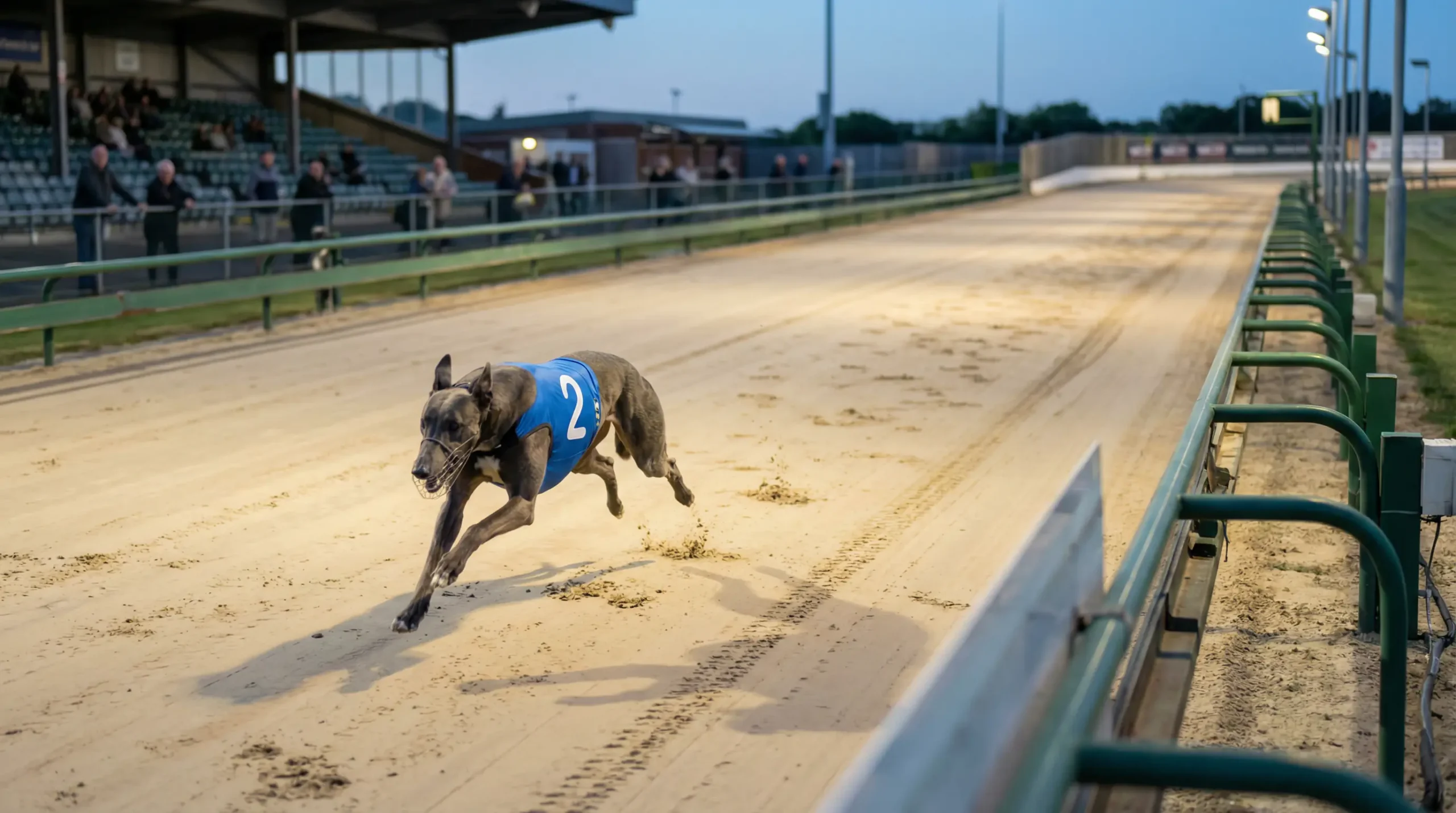
Distance Changes Everything About a Greyhound Race
A sprint specialist running a stayers race is a bet already lost — distance is the first filter. Before you look at form figures, trap draws, or trainer strike rates, the single most important question is whether the dog in front of you has proven ability at the distance it is about to run. Everything else is secondary until that box is ticked.
UK greyhound racing operates across a wide range of distances, from sharp 210-metre dashes that are over in twelve seconds to marathon events beyond 900 metres that test stamina, pack management, and tactical intelligence. The dogs that thrive at one end of this spectrum rarely perform at the other. A dog bred and trained for explosive early pace will fade in a staying event. A dog built for endurance will be outpaced in a sprint before it finds its rhythm. The distance printed on the racecard is not just a number — it defines the type of race, the type of dog that wins, and the type of bet that makes sense.
Understanding the three main distance categories — sprint, middle, and stayer — gives you a framework for filtering races before you even start analysing individual dogs. It also helps explain why certain dogs produce inconsistent form: they are not inconsistent. They are simply being entered at distances that do not suit them.
Sprint Races (210m–300m): Pure Early Pace
Sprints reward trap speed above everything else. These are the shortest races on the card, typically run over two bends at tracks that offer them, and they are decided in the opening seconds. A dog that breaks cleanly from the traps and reaches top speed within three or four strides has an overwhelming advantage, because in a sprint there is simply not enough track left for slower starters to recover.
The most common sprint distances in UK racing sit around 210 metres, 250 metres, and 270 metres, depending on the track. Not every stadium offers sprint races — they tend to feature at tracks with a dedicated short course or a two-bend configuration that allows for a truncated run. Where they do appear, sprints attract a particular type of dog: compact, explosive, with a running style built around early pace rather than sustained speed.
Trap draw is amplified in sprints. The first bend arrives almost immediately, and the dog that reaches it in front usually controls the race from there. Inside draws — traps 1 and 2 — have a measurable advantage in most sprint configurations because they offer the shortest route to the rail before the bend. A wide-drawn dog needs sensational early pace to overcome the geometry, and while it happens, it is the exception rather than the rule.
From a betting perspective, sprints tend to produce more predictable results than longer races. The smaller number of bends reduces the scope for in-running trouble, and the emphasis on raw speed means that the fastest dog on paper is the fastest dog on the track more often than not. That predictability is reflected in the prices — sprint favourites tend to be shorter than their equivalents at middle distances. The value in sprint betting usually comes from identifying a dog with genuine early pace that has been overlooked because its recent form includes poor results at longer distances.
Middle-Distance Races (380m–515m): The Standard
Middle distance is where the form book talks loudest. The vast majority of UK greyhound races fall within this range, with 480 metres being the single most common trip across the licensed circuit (GBGB Racecourses). Races at 400 metres, 462 metres, and 515 metres are also standard at various tracks. This is the bread and butter of British greyhound racing, and it is the distance category where form analysis is most reliable.
The reason form holds up better over middle distances is balance. Unlike sprints, where raw trap speed dominates, middle-distance races require a combination of early pace, bend negotiation, and sustained running down the back straight. A dog that breaks well but cannot maintain its speed through two or four bends will be caught. A dog with a strong finish but poor early pace will find itself too far back to close the gap. The best middle-distance dogs combine both qualities, and their form figures tend to reflect that consistency.
At 480 metres — the standard four-bend trip at most UK tracks — a race lasts roughly 28 to 30 seconds. That sounds short, but it is long enough for positional changes to occur. Dogs that get checked on the first bend can recover if they have the pace to make up ground on the back straight. Dogs that lead early can be overhauled if they lack a finishing kick. This dynamic range is why middle-distance racing produces more competitive markets and more varied results than either sprints or staying events.
For punters, middle-distance races are where the deepest data sits. Because they make up the majority of the card, you have the most historical form to analyse, the most consistent track standards to compare against, and the most reliable sectional time data. If you are building a greyhound betting approach and need a starting point, middle-distance races are where your time invested in form study will return the most useful patterns.
Stayers Races (600m+): Stamina and Tactical Running
Staying races test character as much as speed. Once you get beyond 600 metres, the nature of greyhound racing shifts. Early pace still matters — a dog that gets left at the traps has more ground to recover — but it is no longer the defining factor. Stamina, pack intelligence, and the ability to run bends efficiently at sustained speed become the qualities that separate winners from the rest.
The most common staying distances in UK racing are 630 metres, 660 metres, and 710 metres, with some tracks offering marathon trips at 868 metres and beyond. The English Greyhound Derby, for example, is run over 500 metres at Towcester (GBGB), which is firmly middle-distance, but the major staying events — like the St Leger, run over 710 metres — test dogs at genuine marathon trips. Not all tracks offer staying races. Those that do tend to run them less frequently, which means the sample size for form at these distances can be limited.
Pack running is a significant feature of staying races. With more bends to negotiate and more time for positional changes, dogs spend longer running in close proximity. This means trouble in running — bumping, checking, crowding — is more common at staying distances. A dog that runs cleanly through traffic has an advantage that does not show up in raw time figures but is visible in form comments. If you see a stayer with several recent runs featuring Bmp or Ck codes but still finishing close to the front, that dog may be better than its finishing positions suggest.
Dogs with a strong finishing kick — those that run their fastest in the final hundred metres — tend to find more opportunity at staying distances. In a sprint, there is no time for a finishing kick to matter. Over 700 metres, a dog that is two lengths off the pace at the final bend can close that gap comfortably if it has the stamina to accelerate when others are tiring. Identifying these closers in the form is one of the more profitable angles in staying races, particularly when their form figures show mid-pack finishes that disguise their late-race ability.
How Distance Affects Your Betting Decisions
Always check whether a dog has proven form at the distance — assumed stamina is not actual stamina. This is one of the most commonly overlooked factors in greyhound betting, and it costs punters money with surprising regularity. A dog that has won its last three over 480 metres does not automatically handle 660 metres. The form book might look perfect, but if none of those wins came at a staying trip, you are making an assumption that has no supporting evidence.
The practical approach is straightforward. When you open a racecard, check each dog’s recent form for runs at the same distance. Most form guides include the distance alongside each run. If a dog is entered at 630 metres and its last six runs have all been at 480 metres, that is a question mark. It does not mean the dog cannot stay, but it means you do not know — and a bet placed on something you do not know is not analysis, it is hope.
Distance changes also function as a signal from trainers. When a trainer moves a dog up in distance, they are typically doing so because they believe the dog has untapped stamina, or because the dog is not quick enough to compete at shorter trips. When a trainer drops a dog down, it often means they want to exploit the dog’s pace before it gets caught over longer distances. Neither move is inherently positive or negative, but both should prompt a question: why the change, and has the dog trialled at this distance before?
Match the Dog to the Distance — Not the Other Way Around
The laziest mistake in greyhound betting is ignoring the trip. It happens constantly — a punter sees a dog with good recent form, backs it without checking the distance, and watches it fade in the final hundred metres of a race it was never equipped to finish. The form was real. The selection was wrong. The distance did the damage.
Distance is not a secondary factor you assess after studying form and trap draw. It is the filter you apply first. A dog with mediocre form at 480 metres but two sharp wins at 270 metres might be a strong selection in a sprint race and a liability at anything longer. A dog with declining form figures that has been stepped up to 660 metres for the first time might be about to find its true calling — or it might be a trainer experiment that the bookmaker has not yet priced correctly.
Either way, the starting point is the same: know the distance, know whether the dog belongs there, and let that single piece of information do the heavy lifting before you add anything else to the analysis. Everything in greyhound racing is built on whether the dog can handle the trip. Get that wrong, and nothing else you do matters.