

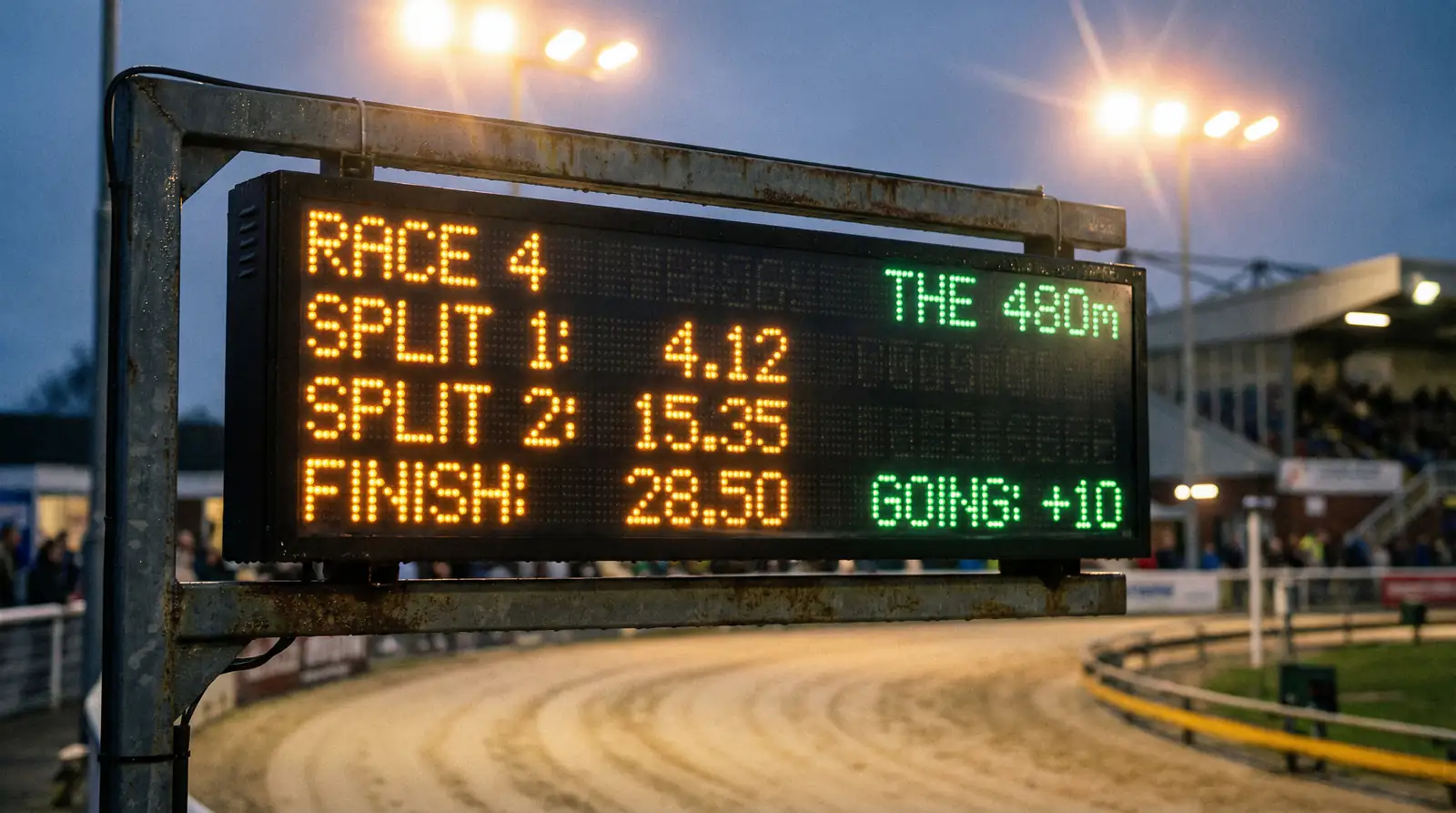
Sectionals Reveal What the Clock Hides
A race time tells you how fast a dog ran from traps to finish line. A sectional time tells you how it got there — whether it burned through the first bend and faded, or whether it was slow into stride and finished like a train. Two dogs can post identical overall times and be completely different animals in terms of running profile. The overall clock treats them as equals. The sectionals expose the difference.
For betting purposes, this distinction is critical. A dog with a fast overall time built on a blistering first sectional and a slow run-in is a front-runner that gets caught if anything disrupts its early lead. A dog with a moderate first sectional but a fast closing split is a finisher that needs the race to unfold a certain way. Both have the same headline time, but they suit different race shapes, different trap draws, and different types of opposition. Sectional times give you the data to make that judgement. Without them, you are working from a summary that hides more than it reveals.
Sectional analysis is one of the areas where greyhound betting rewards effort disproportionately. Most casual punters never look beyond the overall time. The punter who breaks that time into its component parts is working with a richer, more predictive dataset — and that dataset is freely available to anyone willing to spend the time reading it.
What Sectional Times Are and How They’re Calculated
A sectional time is a split time recorded over a specific portion of the race distance. In UK greyhound racing, the most common sectional breakdown divides a race into two segments: the time from the traps to a fixed point (usually the first or second bend, depending on the track) and the time from that point to the finish line. Some tracks and data providers offer more granular splits — three or even four segments — but the two-segment model is the standard that most form databases publish.
The first sectional is typically called the “run-up” or “early pace” time. It measures how quickly the dog reaches the first timing point, which at most tracks corresponds roughly to the first bend. This split captures the dog’s trap speed — how fast it breaks — and its ability to reach racing pace in the opening strides. Dogs with consistently fast first sectionals are early-pace runners. They want to lead, and their form is built on getting to the front before the pack settles.
The second sectional — often called the “run-in” or “closing” split — covers the remainder of the race. This is the stamina and sustained-speed portion. A dog that posts a slow first split but a fast second split is finishing the race stronger than it started, which suggests it has reserves of energy that were not deployed early. These dogs are closers, and their best races typically come when the early pace is strong enough to tire the front-runners before the final straight.
Sectional times are calculated by timing equipment installed at the track. The technology varies — some tracks use photoelectric beam systems, others use transponder-based tracking — but the output is the same: a time in hundredths of a second for each segment of the race. These figures are then published as part of the full race result, either directly on the track’s own system or through data aggregators like Timeform and specialist greyhound databases.
Calculated sectional times also exist. These are derived by subtracting the first split from the overall time, or vice versa, and they appear when only one sectional is directly measured. If the timing system records the run-up time and the overall time, the run-in time is calculated as the difference. This is standard practice and generally reliable, though it can introduce small rounding errors that become relevant only when comparing very close splits across multiple races.
Not all tracks publish sectional data with equal detail. Larger, better-equipped stadiums tend to offer the most comprehensive timing data, while smaller venues may only publish overall times. If you specialise in a track that provides good sectional data, you have a natural analytical advantage over punters working with tracks that do not.
Early Pace vs Run-In: Reading the Splits
The relationship between a dog’s first and second sectional tells you its running profile, and that profile is one of the most useful pieces of information for predicting how it will perform in its next race. The key is not the absolute speed of either split in isolation — it is the ratio between them and what that ratio reveals about the dog’s energy distribution across the race.
A dog that consistently records fast first sectionals and slower second sectionals is a pace-dependent runner. It needs to lead or sit close to the lead through the first half of the race, because its speed drops in the second half. This type of dog is most vulnerable when drawn in a wide trap where it cannot establish position early, or when racing against another strong early-pace dog that forces it to expend more energy in the opening strides than it can sustain.
A dog with moderate first sectionals and fast closing splits is a finisher. It sits behind the pace, conserves energy through the early bends, and accelerates in the final straight. Finishers are less dependent on trap draw because they do not need to lead into the first bend — they need clear running in the second half of the race. Their risk is different: if the early pace is slow and the field stays bunched, they have no gap to close and their finishing speed goes unused.
The most dangerous dogs in any field are those with fast splits in both halves — front-runners that do not fade. These dogs are relatively rare, and when they appear in a graded race, they tend to be short-priced favourites because the form is so visually dominant. The sectional data confirms what the finishing positions suggest: this dog is faster at every stage of the race, and its win probability is genuinely higher than the field.
Where sectionals become most profitable is in identifying dogs whose overall times underrepresent their ability. A dog that finished fourth in a moderate overall time but posted the fastest closing sectional in the race was finishing stronger than everything ahead of it. If the race had been ten metres longer, it might have won. If it ran with the same profile next time and got a slightly better early position, the result could be entirely different. That information is invisible in the overall time. It is obvious in the sectionals.
Comparing Sectionals Across Different Tracks
Cross-track comparison of sectional times is one of the trickiest areas of greyhound analysis, because the measurement points are not standardised. The “first bend” at one stadium is not the same distance from the traps as the “first bend” at another. The timing point for the first sectional might be 100 metres from the boxes at one track and 130 metres at another. This means a first sectional of 4.5 seconds at Track A and 4.5 seconds at Track B do not necessarily describe the same speed — the dog at Track B might have covered more ground in the same time.
The reliable way to compare sectionals across tracks is to convert them into metres-per-second or to use the track’s published standard time as a baseline. If the average first sectional at Track A is 4.3 seconds and your dog ran 4.1, it is 0.2 seconds faster than the standard. If the average at Track B is 4.7 seconds and the same dog ran 4.5, it is also 0.2 seconds faster than that standard. The absolute times are different, but the relative performance is identical. This relative approach — measuring deviation from the track standard rather than comparing raw times — is the only valid method for cross-track sectional analysis.
Track surface also affects sectional comparison. A sand track running fast in dry conditions will produce quicker sectionals than the same track on a wet night. If you are comparing a dog’s sectional from a dry card with another dog’s sectional from a wet card at the same track, the raw numbers are misleading. Adjusting for going conditions — even informally, by noting whether the overall track standard on that night was faster or slower than usual — makes the comparison meaningful.
For punters who specialise in one or two tracks, cross-track comparison is less relevant because your database is internally consistent. The splits you have accumulated over weeks and months all come from the same timing system, the same measurement points, and the same track geometry. This internal consistency is one of the strongest arguments for single-track specialisation: your sectional data is directly comparable race to race, and the patterns you identify are real rather than artefacts of different measurement setups.
The Clock Doesn’t Lie — But You Have to Read It Right
Sectional times are the most underused form tool in greyhound betting. The data is there, published after every race at every track that records it, and the vast majority of punters never look at it. They check the finishing position, glance at the overall time, and move on. The punter who pauses long enough to read the splits — to see that the fourth-placed dog ran the fastest closing sectional, or that the winner was slowing down significantly through the second half — is extracting twice the information from the same result.
The skill is not in reading individual sectionals but in reading them across sequences. A dog that has posted fast closing sectionals in three consecutive races is showing a repeatable pattern, not a one-off. That pattern tells you something definitive about its running style and about the conditions under which it is most likely to win. A different dog whose first sectionals have been getting progressively faster over recent runs might be improving in fitness or sharpness — a signal that the next race, rather than the last one, is where the performance peaks.
Treat sectionals as the second layer of form, sitting beneath the headline figures of position and overall time. The surface data answers the question “what happened.” The sectionals answer the more useful question: “how did it happen, and what does that mean for next time?”
Get more form data at greyhoundresultsyester.
Also see our form guide.
