
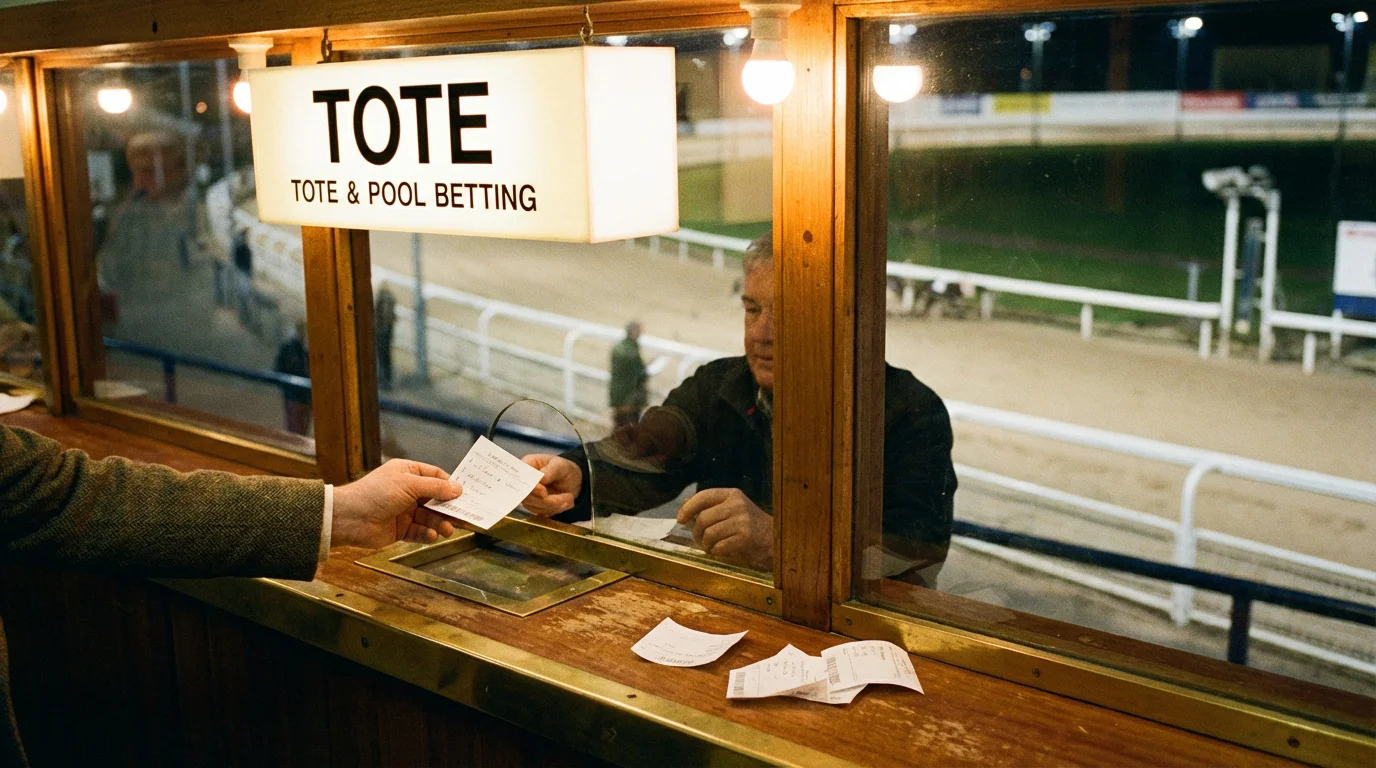
Pool Betting: Different Money, Different Rules
Pool betting operates on a fundamentally different principle from fixed-odds betting with a bookmaker. When you place a fixed-odds bet, you agree a price with the bookmaker at the time of the bet, and that price determines your return if you win. When you place a pool bet, your stake goes into a collective pot along with every other punter’s money on the same race. The pool is then divided among the winners after the race, with the payout determined by how much money went in and how many people backed the winning outcome. You do not know your exact return until the race is over.
In UK greyhound racing, pool betting is primarily associated with the Tote — the pari-mutuel system that operates at licensed tracks and through some online platforms. The Tote has a long history in British racing, and while it is more commonly associated with horse racing, it has a significant presence at greyhound tracks where trackside pool betting remains a popular way to wager, particularly among punters attending meetings in person.
The appeal of pool betting is that the returns are driven by collective behaviour rather than a bookmaker’s margin. If you back an outcome that the majority of the pool has ignored, your share of the dividend can exceed anything a fixed-odds bookmaker would have offered. The risk is the reverse: if everyone backs the same dog, the pool is split thinly and the return may be worse than the fixed-odds price. Understanding when pool betting offers better value than fixed odds — and when it does not — is a useful addition to any greyhound punter’s toolkit.
How Tote Pools Work at Greyhound Tracks
The mechanics of Tote pool betting are straightforward. All stakes on a particular bet type for a given race are combined into a single pool. The track operator deducts a percentage — the takeout — which covers operating costs and profit. The remainder of the pool is then divided proportionally among the winning tickets. If the pool contains one thousand pounds after takeout and ten tickets backed the winner, each ticket receives one hundred pounds. If only two tickets backed the winner, each receives five hundred.
The takeout percentage varies by pool type and by operator, but it typically ranges from 15% to 30% in UK greyhound racing. This is higher than the effective margin on most fixed-odds bets, which means the pool starts at a mathematical disadvantage compared to a bookmaker bet. The pool compensates for this higher takeout through the possibility of outsized returns when the winning outcome is lightly backed — returns that the fixed-odds market would never offer because the bookmaker would have priced the dog more accurately.
Tote pools at greyhound tracks are available both on-course and, to a more limited extent, online. At the track, Tote windows or self-service terminals accept pool bets on every race. The minimum stake is typically low — one or two pounds — making pool betting accessible to casual racegoers as well as regular punters. Online, Tote pool access for greyhound racing is less comprehensive than for horse racing, though some platforms do offer it on selected meetings.
The pool dividend is displayed after each race on the trackside screens and published in the results. It is expressed as a return to a one-pound stake — so a dividend of “8.40” means a one-pound winning bet returns eight pounds forty, including the original stake. This figure is the only way to know the actual return, because unlike fixed odds, the price is not determined until after the race.
One important detail: pool dividends are calculated independently of the fixed-odds market. The Tote does not reference the bookmaker’s starting price. The two systems operate in parallel, which means the Tote dividend can be higher or lower than the SP. On popular favourites that attract heavy pool money, the Tote dividend is often lower than the SP. On lightly backed outsiders, it can be significantly higher.
Jackpot, Exacta and Other Pool Bet Types
The Tote offers several bet types beyond the simple win pool, each with its own structure and its own potential return profile. The win pool is the most basic: pick the winner of a single race. The place pool pays on the first two finishers, with the pool divided among those who backed either placed dog. Place pool dividends are naturally smaller than win pool dividends because more outcomes qualify for a payout.
The Exacta is the pool equivalent of a forecast bet. You select the first and second finishers in exact order, and the pool is divided among those who matched the correct combination. Because predicting the exact first-and-second finish is harder than picking a single winner, Exacta pools tend to produce larger dividends per winning ticket. In races where the placed result is unexpected — where a longer-priced dog finishes first or second — the Exacta dividend can be substantial, because fewer tickets will have matched the combination.
The Trifecta extends this to the first three finishers in exact order, mirroring the tricast in fixed-odds betting. Trifecta pools produce the largest individual dividends of any standard pool bet, because the number of possible outcomes in a six-dog race (120 permutations for the top three) means winning tickets are rare. A successful Trifecta on a result involving a longer-priced dog can return several hundred or even several thousand pounds from a small stake.
Jackpot pools require you to pick the winner of multiple consecutive races — typically six. The pool accumulates across all six races, and only tickets that correctly name all six winners share the dividend. If no ticket matches all six, the pool rolls over to the next meeting. Jackpot pools are the highest-variance bet type available on greyhounds. The dividends when someone wins can be enormous — five-figure sums from small stakes — but the probability of correctly naming six consecutive winners is extremely low. Jackpot betting is entertainment, not strategy.
Some tracks and platforms also offer Quartet pools (first four in order) and Swinger pools (two dogs to finish in the top three in any order), though availability varies by venue. The common thread across all pool types is the same: your return depends on how many other punters backed the same outcome, not on a fixed price agreed in advance.
Tote vs Fixed Odds: When Pool Betting Pays Better
The decision between Tote and fixed odds is not ideological — it is mathematical. On any given race, one or the other will offer a better return on the same selection, and the difference can be significant. The practical question is whether you can predict, before the race, which system will pay more.
Pool betting tends to outperform fixed odds when the winning dog is a longer-priced runner that the pool has largely ignored. In those situations, the small number of winning tickets means each one receives a larger share of the total pot. Fixed-odds bookmakers price longer shots with less precision in greyhound racing — the market is less liquid and the prices are less competitive at the extremes — but the Tote dividend for a genuine surprise can exceed even a generous bookmaker price because the pool mathematics reward minority opinion more aggressively.
Fixed odds tend to outperform the Tote on favourites and short-priced selections. When the majority of the pool money backs the same dog, the pool dividend is compressed by the large number of winning tickets sharing the pot. The fixed-odds price on the same dog, taken early, is often better because the bookmaker’s price was set before the full weight of public money arrived. This is the scenario where Best Odds Guaranteed adds further value to fixed-odds betting — the price you took cannot get worse, but the pool dividend has no such floor.
The practical approach for most punters is to default to fixed-odds betting and switch to the pool when specific conditions suggest the Tote dividend will be superior. Those conditions are: a competitive, open race where no single dog is attracting dominant pool money; a selection at longer odds that you believe the majority of pool bettors have overlooked; and a race where the Exacta or Trifecta structure of the pool matches a forecast or tricast opinion you already hold. Outside those conditions, fixed odds with BOG protection is almost always the more reliable choice.
The Pool Rewards Patient Money
Pool betting is not a replacement for fixed-odds greyhound betting. It is an alternative with a different return structure that occasionally produces better results under specific conditions. The punter who understands both systems — who knows when the pool offers a structural advantage and when fixed odds are the smarter choice — has an additional option that most competitors do not consider.
The Tote’s strength lies in its treatment of minority opinions. If your form analysis identifies a winner that the majority of the betting public has dismissed, the pool is the mechanism that rewards your contrarian view most generously. The fewer people who agree with you, the larger your share. That dynamic does not exist in fixed-odds betting, where the bookmaker sets the price and your return is determined at the moment you place the bet.
Use pool betting selectively. Target it at races where the form points to an outcome the market is underweighting. Avoid it on heavy favourites where the pool will be crowded and the dividend compressed. And treat the higher takeout as the cost of accessing a return structure that, in the right conditions, pays better than anything a bookmaker will offer.