
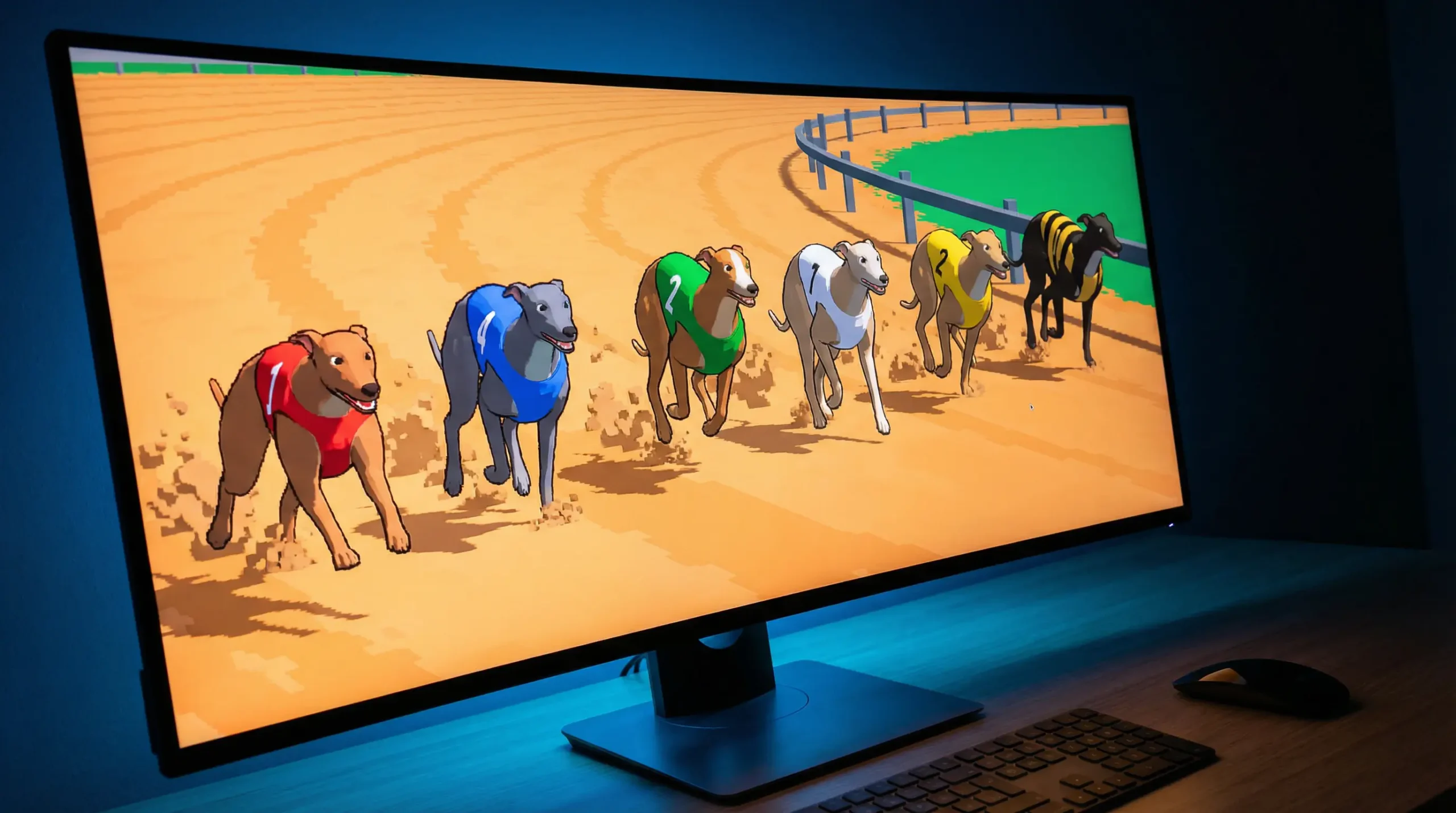
Virtual Dogs: Real Money, Simulated Races
Virtual greyhound racing is a computer-generated simulation that produces a race result every few minutes, round the clock, with no real dogs involved. The races are animated, the outcomes are determined by a random number generator, and the betting markets are constructed by algorithms rather than bookmaker traders. You can place a bet on a virtual greyhound race at three in the morning on a Tuesday, and the race will happen within sixty seconds. That convenience is the product’s entire selling point.
The virtual greyhound product exists because there are gaps in the live racing calendar that bettors want filled. Live UK greyhound meetings typically run from late morning through to the last race around ten at night. Outside those hours — and during breaks between meetings — virtual racing provides a continuous stream of betting opportunities. Bookmakers offer it because it generates revenue. Punters use it because it is available. Whether it should be approached with the same analytical mindset as live racing is a question with a clear answer: it should not.
Virtual greyhound racing and live greyhound racing share visual aesthetics and basic terminology, but they are fundamentally different products. One is a sport where real dogs compete and where form, fitness, trap draw, and conditions determine the outcome. The other is a random number generator wearing a graphical skin. Understanding that distinction is essential before placing a single pound on a virtual race.
How Virtual Greyhound Racing Works
Every virtual greyhound race is generated by software. The process begins with a random number generator — a certified RNG system that produces an outcome before the animated race even starts. The visual simulation you watch on screen is a rendering of a pre-determined result, not a live competition. The dogs are not racing each other in any meaningful sense. The algorithm has already decided who wins, who finishes second, and who trails in last before the virtual traps rise.
The RNG systems used by licensed bookmakers are tested and certified by independent auditing bodies to ensure statistical fairness. This means that over a large sample of races, each virtual dog wins approximately the expected proportion of the time relative to its assigned probability. The odds displayed before the race reflect these probabilities. A virtual dog listed at 3/1 has roughly a 25% chance of winning, and over thousands of races, it will win close to that percentage. There is no house edge hidden in the outcome generation itself — the bookmaker’s margin is built into the odds, the same as in any other betting product.
Races run on a rapid cycle. Depending on the provider, a new virtual greyhound race is available every two to four minutes. The standard format mirrors live racing: six dogs, trap colours, a simulated track. Some providers assign names and form figures to the virtual dogs, which creates an illusion of continuity and form, but these are cosmetic. A virtual dog’s “previous results” are generated by the same RNG and have no predictive relationship to its next race. There is no form to study because there is no real form.
The major virtual racing providers supplying UK bookmakers include Inspired Entertainment (Inspired Entertainment) and Kiron Interactive, with SIS distributing virtual content through its 49’s brand (SIS). Each uses slightly different graphics, race cycles, and presentation styles, but the underlying mechanism is the same across all of them: RNG output, animated to look like a race, with odds set to reflect the pre-determined probabilities.
Bet types on virtual greyhounds largely mirror those available on live racing. You can place win bets, forecast bets, tricast bets, and in some cases each way bets. The payouts are calculated in the same way — win odds are fixed at the time of placement, and forecast and tricast dividends are computed based on the result. The main difference is speed: there is no waiting between races, no form to analyse, and no market movement to monitor.
Virtual vs Live Greyhound Racing: Key Differences
The differences are not subtle — they are structural, and they affect every aspect of how you should approach the product. Live greyhound racing involves real animals with physical characteristics, training histories, running styles, and measurable form data. The outcome of a live race is influenced by dozens of variables: trap draw, going conditions, early pace, trouble in running, the dog’s fitness on the night, the trainer’s preparation. A punter who studies these variables can build a genuine edge over the market. Virtual racing has none of this. The outcome is random, and the variables are decorative.
Form analysis — the foundation of profitable greyhound betting — is entirely irrelevant in virtual racing. A virtual dog that “won” its last three races has no higher probability of winning the next one than a virtual dog that “lost” its last ten. The displayed form figures are cosmetic outputs from the same RNG that will determine the next result independently. Treating virtual form as real form is the single most common mistake punters make when crossing over from live to virtual racing. It feels natural to apply the same habits, but the habits have no application.
Market dynamics are also absent. In live racing, odds move in response to money. When informed punters back a dog, its price shortens, which signals information to the rest of the market. In virtual racing, the odds are static — set by the algorithm and unchanged by market activity. There are no informed punters, no market signals, and no late money to interpret. The price you see is the probability the software has assigned, minus the bookmaker’s margin.
Speed of play is the other critical distinction. A live greyhound meeting contains between ten and fourteen races, spread across two to three hours. A virtual session can pack the same number of races into thirty minutes. The rapid cycle creates a pace of betting that is significantly faster than live racing, which carries specific risks for bankroll management and impulse control. The time between races in live racing provides a natural cooling period — time to review the last result, study the next card, and make a considered decision. Virtual racing compresses that gap to near zero, which encourages reactive betting rather than deliberate selection.
Is There a Strategy for Virtual Greyhounds?
The honest answer is no — not in the way that strategy exists for live greyhound racing. In live racing, strategy means analysing form, identifying value, and exploiting market inefficiencies. In virtual racing, the outcome is random and the odds are algorithmically fair (minus margin), which means no amount of analysis can shift the expected value in the punter’s favour. Over a large enough sample, you will lose the bookmaker’s margin on every virtual bet, regardless of your approach.
That said, there are frameworks that some punters apply to manage their virtual betting, even if these do not constitute strategy in the traditional sense. Staking discipline is the most important. Because virtual races run every few minutes, the temptation to increase stakes after a loss — or to chase a losing streak — is amplified by the speed of play. Setting a strict session budget and walking away when it is spent is not a strategy for winning. It is a strategy for not losing more than you planned to.
Some punters prefer to target forecasts and tricasts on virtual racing rather than simple win bets. The logic is that the higher dividends from forecast and tricast bets provide larger occasional returns that offset the more frequent losses. Mathematically, this does not change the expected value — the bookmaker’s margin is baked into all bet types — but it does change the variance profile. You lose more often but win more when you do, which some punters find more engaging than the steady drip of small win bet losses.
What definitively does not work is applying live racing logic to virtual dogs. Backing the “form” selection, studying trap bias in virtual results, or looking for patterns in the RNG output is wasted effort. The RNG is certified to produce statistically independent outcomes, which means each race is a clean slate with no connection to any previous result. Pattern-seeking in random data is a well-documented cognitive bias, and virtual racing is a near-perfect environment for triggering it. The dogs have names and numbers and previous results, all of which create the illusion of continuity where none exists.
Virtual Racing Fills a Gap — Just Know What You Are Betting On
Virtual greyhound racing serves a specific purpose in the betting landscape: it provides a continuous betting product when live racing is not available. For punters who want the experience of placing a bet at any hour, it delivers exactly that. The animations are polished, the bet types are familiar, and the cycle is fast enough that there is always another race about to start.
The danger lies in conflating the virtual product with the real sport. A punter who treats virtual greyhounds as a substitute for live form-based betting will spend money without any possibility of building a sustainable edge. The skills that make someone profitable at the live dogs — reading form, assessing trap draw, understanding grading changes — have zero application in virtual racing. Bringing those skills to a virtual race does not make you a better virtual bettor. It makes you a live racing analyst applying expertise to a random number generator.
If you choose to bet on virtual greyhounds, treat it as what it is: a game of chance with a negative expected value, designed for entertainment. Set a budget, stick to it, and do not let the rapid race cycle pull you into spending more than you intended. The virtual product is at its most dangerous when a punter starts the session casually and then begins chasing losses through the relentless availability of the next race. The next race is always thirty seconds away. That is a feature of the product and a risk for the punter in equal measure.