
Tricast: The Most Demanding Greyhound Bet
Predicting first, second and third in exact order is the sharpest test any greyhound punter faces. A tricast takes the difficulty of a forecast and raises it by a full position — you are not just naming the top two, you are calling the precise order of the top three finishers. In a six-dog race, there are 120 possible permutations for the first three positions. A straight tricast asks you to identify one specific combination out of those 120. The payouts reflect the difficulty.
Tricast betting occupies a particular niche in greyhound racing. It is not a bet for every race, and it is certainly not a bet for punters who study only one or two dogs on the card. It rewards comprehensive field analysis — the kind of work where you have a genuine opinion on every dog’s likely finishing position, not just the winner. When you get it right, the returns can be extraordinary. When you get it wrong, you lose your stake with nothing to show for it, the same as any other losing bet. The difference is that tricasts lose more often than most bet types, which is why they demand a more selective, disciplined approach.
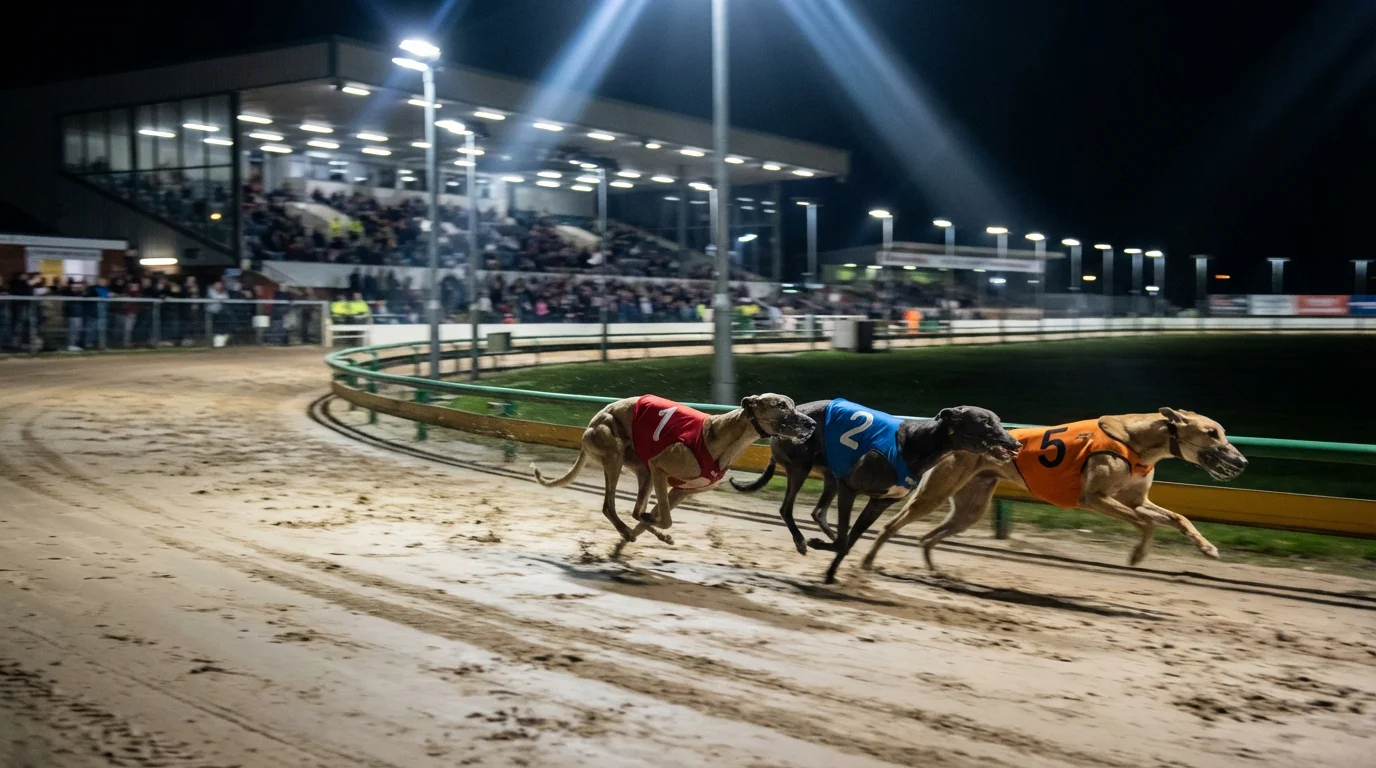
Greyhound racing is arguably the best sport for tricast betting precisely because of the six-dog field (GBGB). The smaller field size, compared to horse racing, makes the task more realistic without making it easy. The dogs run without jockeys, which removes a layer of tactical unpredictability. And the form data — times, trap draws, running comments — gives you enough information to build a genuinely informed view of the top three, provided you are willing to do the work.
Straight Tricast: Exact 1-2-3 Finish
Three dogs, one specific order — get any position wrong and the entire bet is dead. A straight tricast requires you to name the first, second, and third-place finishers in the precise order they cross the line. If any of your three selections finishes in the wrong position — even by a single place — the bet loses. Dog A wins and Dog B finishes second but Dog C comes fourth instead of third? The tricast is dead.
The dividend for a straight tricast is calculated using the Computer Tricast formula, similar in principle to the Computer Straight Forecast used for forecast bets. The payout is determined after the race based on the starting prices of the first three finishers. Because three positions are involved and the probability of calling all three correctly is low, tricast dividends are consistently higher than forecast dividends for the same race. Where a forecast might return ten to fifty times the stake, a tricast routinely returns fifty to several hundred times the stake, and in races involving longer-priced dogs, the dividend can push into four figures from a single unit bet.
Typical return ranges depend heavily on the prices of the dogs involved. A tricast containing three short-priced dogs — the 2/1 favourite, the 3/1 second choice, and the 4/1 third choice — might produce a dividend somewhere in the range of twenty to sixty pounds for a one-pound stake. That is decent, but not transformative. A tricast where the second or third finisher is a 10/1 or longer shot can produce dividends of two hundred, five hundred, or even over a thousand pounds. The presence of even one longer-priced dog in the top three dramatically inflates the return, because the Computer Tricast formula weights the prices of all three finishers.
This dynamic creates a specific logic for straight tricast selection. You want your first pick to be the dog you are most confident about — ideally a strong favourite or clear form pick that anchors the bet. Your second pick should be a dog with demonstrable place form, one that consistently finishes close to the front. Your third pick is where the skill — and the value — really comes in. This is the position where a longer-priced dog can appear, and where having an opinion that differs from the market is most profitable. If the field contains a dog that the market has at 8/1 or 10/1 but whose form suggests it is capable of finishing third, placing it in the third slot of a straight tricast is one of the highest-value plays available in greyhound betting.
The discipline required is significant. You will lose more tricast bets than you win, by a wide margin. The strike rate for straight tricasts, even for skilled punters, is low. The question is not how often you win but how much you collect when you do. One successful tricast with a three-figure dividend can cover weeks of unsuccessful attempts. The maths works only if you keep your unit stakes controlled and treat tricasts as a selective weapon rather than a routine bet type.
Combination Tricast: Covering All Permutations
More coverage, more cost — three dogs equal six lines, four dogs equal twenty-four lines. A combination tricast allows you to select three or more dogs and cover every possible ordering of first, second, and third between them. It removes the need to specify exact positions, trading that precision for a higher outlay.
With three dogs, the maths is manageable. There are six possible orderings of three dogs across three positions (A-B-C, A-C-B, B-A-C, B-C-A, C-A-B, C-B-A), so a three-dog combination tricast costs six times your unit stake. This is the most common form of combination tricast in greyhound racing, and it works well when you are confident that three specific dogs will fill the top three places but genuinely unsure about the finishing order.
With four dogs, the permutations escalate sharply. You are now covering every possible way four dogs can fill three positions, which produces twenty-four lines. At one pound per line, the total stake is twenty-four pounds. The return is still the Computer Tricast dividend for whichever single permutation lands, so you need a dividend of at least twenty-four pounds to break even and significantly more to produce a worthwhile profit. Four-dog combinations are viable, but they demand that at least one dog in the finishing order be at long enough odds to generate a dividend that justifies the outlay.
With five dogs — sixty permutations, sixty pounds at a one-pound unit — the economics become difficult. You are covering half of all possible tricast outcomes in a six-dog race, which sounds comprehensive, but it means the dividend needs to be substantial to overcome the cost. In practice, five-dog combination tricasts are rarely good bets unless the race features extreme outsiders who could inflate the dividend if they finish in the top three. Most experienced punters stop at three or four dogs and accept the risk of missing rather than overcovering at excessive cost.
The break-even calculation is the critical tool for deciding whether a combination tricast is worth placing. Before the race, estimate the likely CSF dividends for the various permutations. If the lowest plausible dividend exceeds your total stake by a comfortable margin, the combination is viable. If the dividend in the most likely permutation only just covers the stake, you are taking on risk for minimal reward, and a straight tricast on your strongest opinion would be a better play.
When Tricast Betting Makes Sense
Tricasts work in specific race shapes — not every race is tricast-worthy. The single most important condition is a clear separation between the dogs you believe will fill the top three and the dogs you believe will not. If a six-dog race looks genuinely open, with every runner having a plausible chance of finishing in any position, tricast betting is a poor fit. You would need to cover too many combinations, and the cost would outweigh the expected return.
The ideal tricast race has a structure that looks something like this: two or three dogs with strong, recent form that clearly separates them from the rest of the field, combined with one or two other dogs that have enough ability to fill a podium position but are priced at longer odds by the market. That combination gives you confidence in narrowing the top three while ensuring the dividend will be large enough to justify the bet.
Open races and higher-grade events tend to produce better tricast conditions than lower-grade affairs. In A1 or open races, the form data is more reliable, the dogs are more consistent, and the separation between the top three and the bottom three in the field is often more visible. In lower grades, where dogs are less predictable and more likely to produce erratic runs, the tricast becomes harder to construct with confidence.
Races with a dominant favourite can also be good tricast territory, perhaps counterintuitively. If one dog is a strong 1/2 or 4/6 favourite and is highly likely to win, the uncertainty shifts entirely to the second and third positions. A straight tricast with the favourite in first and two longer-priced dogs in second and third can produce a healthy dividend, because the Computer Tricast calculation rewards longer prices in any of the three positions. The favourite winning is the likely scenario. The question is which two dogs follow it home — and if your answer differs from the market consensus, that is where the tricast pays.
Tricast Is Not a Gamble — It Is a Precision Instrument
Use it sparingly, use it when the race reads right, and the returns will justify the patience. The tricast is the most misused bet type in greyhound racing — not because punters do not understand it, but because they apply it to the wrong races. A tricast placed on impulse in a competitive low-grade race is a lottery ticket. A tricast placed after careful form analysis in a race with a clear top-three structure is a calculated bet with an outsized return profile.
The discipline that tricast betting requires is not about suppressing the urge to bet. It is about waiting for the right race shape. Some cards will offer two or three races that fit the tricast criteria. Some cards will offer none. The punter who accepts that and restricts tricast bets to situations where the form genuinely supports a top-three prediction will, over time, produce a return profile that straightforward win betting simply cannot match.
The six-dog field is what makes greyhound tricasts viable in a way that horse racing tricasts rarely are. With only 120 possible permutations instead of the thousands that a twelve-runner handicap produces, a well-prepared punter can realistically eliminate half the field and focus on the three or four dogs that matter. The absence of a jockey removes a variable, and the standardised track conditions make form comparison more reliable. All of those factors tilt the tricast from pure gambling towards informed prediction — but only for the punter who treats it with the selectivity and preparation it demands. The tricast does not reward volume. It rewards precision.