
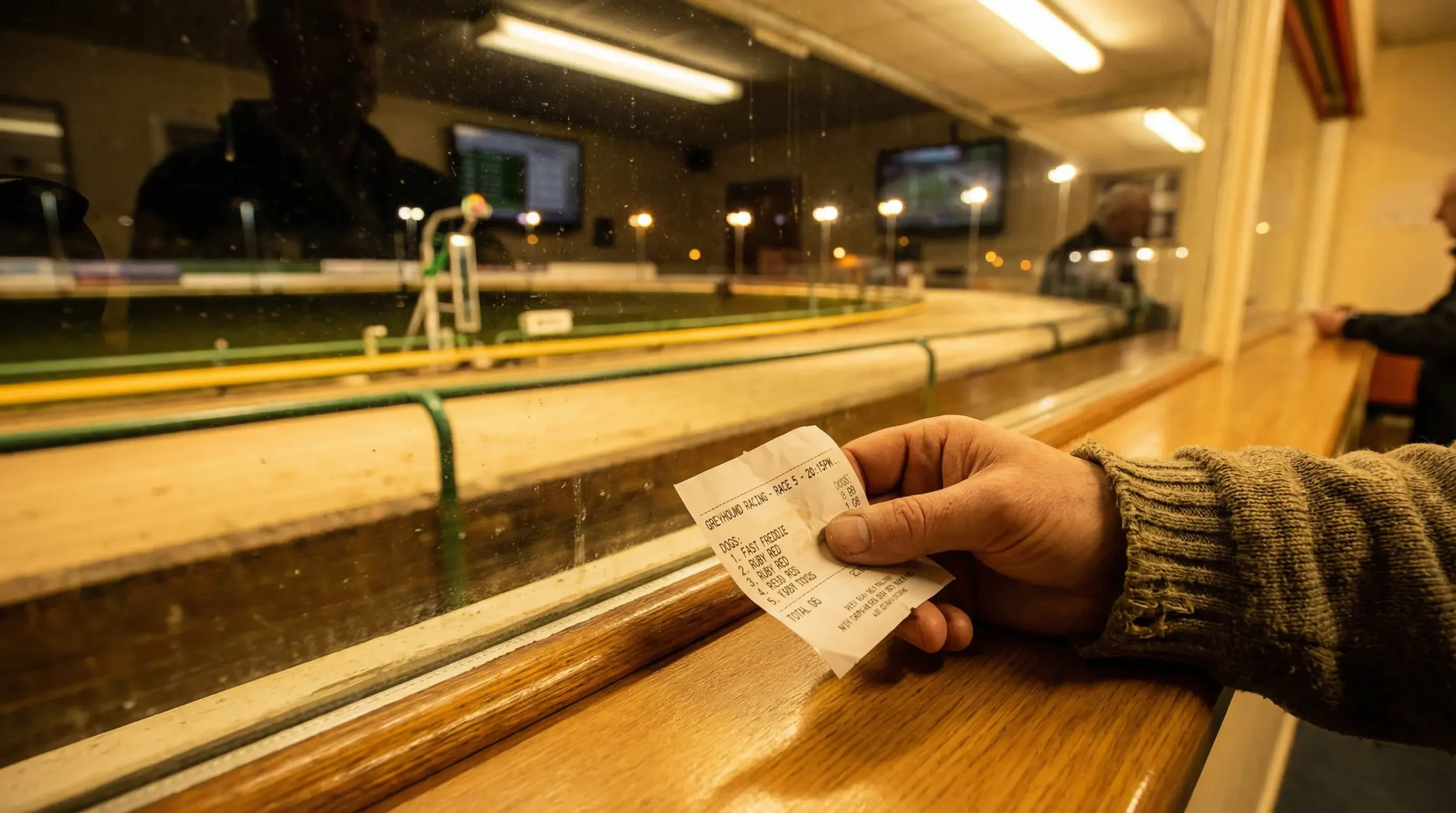
More Ways to Bet Than Dogs in the Race
Six runners, one winner — but the ways to stake your money stretch well beyond picking first past the post. Greyhound racing in the UK supports a betting menu that runs from the utterly straightforward to the genuinely complex, and the type of bet you choose shapes everything from your potential return to the amount of homework you need to do before the traps open. Races at all GBGB-licensed tracks are contested by six-dog fields.
At one end of the spectrum, a simple win bet is exactly what it sounds like: pick a dog, back it, collect if it finishes first. At the other end, a combination tricast asks you to identify the first three dogs home in any order across multiple permutations — a wager that requires a deeper read of the race and carries payout potential that a win bet cannot touch. Between those two poles sit each-way bets, forecasts, accumulators, match bets, trap challenge markets and pool-based Tote wagers, each with its own mechanics, its own risk profile and its own place in a punter’s strategy.
The mistake most newcomers make is not choosing the wrong bet type — it is betting in a format they do not fully understand. An each-way bet placed at the wrong odds is a slow leak dressed up as a safety net. A combination forecast without a proper grasp of the permutation costs can burn through a bankroll in an evening. The purpose of this guide is to lay out every major greyhound bet type with enough detail that you can decide which ones suit your approach, your appetite for risk and the size of your betting bank.
We will work from the simplest to the most complex, and by the end, you should know not just what each bet type is, but when it makes sense to use it — and when it does not.
Win Bets and Place Bets: The Foundation
Start here — everything else builds on this. A win bet is a wager on a single dog to finish first. You choose the dog, decide your stake, and if it crosses the line ahead of the other five, you collect the stake multiplied by the odds. If it finishes anywhere else, you lose the stake. That is the entire transaction.
The odds you receive depend on when and how you place the bet. If you take a fixed price — locking in the odds at the moment you place the bet — those are the odds you are paid at, regardless of what happens to the market before the race starts. If you choose Starting Price (SP), your odds are determined at the moment the traps open, based on the final state of the market. The difference can be significant. A dog that opens at 5/1 in the morning might drift to 7/1 by race time if money comes for other runners, or shorten to 3/1 if it attracts late support. Fixed-price punters know exactly what they are getting; SP punters are at the mercy of the market.
Some bookmakers offer Best Odds Guaranteed (BOG) on greyhound racing, which gives you the higher of your fixed price or the SP. If you take 5/1 and the dog goes off at 8/1, you get paid at 8/1. Not all operators extend BOG to greyhounds — it is more common on horse racing — so it is worth checking before you bet. Over the long run, BOG is one of the most valuable promotions available to a greyhound punter.
Place bets work differently. In a standard six-dog greyhound race, place terms typically cover the first two finishers (Timeform: Bet Types Guide). This is narrower than horse racing, where an eight-runner field might pay three places. Backing a dog “to place” means it needs to finish first or second for you to collect. The place odds are a fraction of the win odds — usually one quarter of the win price. So if a dog is 8/1 to win, the place part pays 2/1. Place bets on their own are not common in greyhound racing; they are more often seen as the place component of an each-way bet, which we will cover next.
One detail that catches new punters out: in races with fewer than six runners — which can happen when dogs are withdrawn late — place terms may change or place betting may not be offered at all. Five-runner races at some bookmakers only pay one place, which obviously reduces the value of any each-way or place bet substantially. Always check the race conditions before staking.
Each Way Betting on Greyhounds
Each way sounds like a safety net — and sometimes it is, but the maths is not always in your favour. An each-way bet is two bets in one: a win bet and a place bet, at equal stakes. If you place a ten-pound each-way bet, you are staking twenty pounds total — ten on the dog to win and ten on it to place (first or second in a six-runner field). If the dog wins, both parts pay out. If it finishes second, you lose the win stake but collect the place part.
In UK greyhound racing, the standard place terms are one quarter of the win odds for the first two places. So if your dog is priced at 8/1, the place portion pays at 2/1. On a ten-pound each-way bet, a winning dog at 8/1 returns one hundred and five pounds total: eighty from the win part (ten times eight) plus ten from the win stake returned, and twenty-five from the place part (ten times two, plus the ten-pound place stake returned). If the dog finishes second, you lose the ten-pound win stake and collect twenty-five from the place part, leaving you with a net gain of five pounds.
The question that matters is: at what odds does each-way betting actually add value? The break-even point depends on how often the dog places versus how often it wins. As a rough guide, each-way betting starts to make mathematical sense when the dog’s odds are around 4/1 or higher. At shorter prices — 2/1, 5/2 — the place return is too small to compensate for the doubled stake. At 4/1, the place payout of Evens (1/1) at least gives you a modest return on a second-place finish. At 8/1 or 10/1, the place return becomes substantial enough to justify the extra outlay, provided you genuinely believe the dog has a strong chance of finishing in the first two.
The trap that catches each-way bettors on greyhounds is the two-place limit. In horse racing, each-way bets in larger fields (twelve or sixteen runners) cover three or four places, which significantly increases the likelihood of at least recovering the place stake. In a six-dog greyhound race, you need to be in the top two — which is one in three before you factor in ability. That is a harder threshold to clear, and it means each-way value is more concentrated at bigger prices. Backing 6/4 shots each way on greyhounds is, over a long enough sample, a reliable way to erode your bankroll.
The disciplined approach is to reserve each-way bets for dogs you have assessed as having a genuine win chance but whose main risk is one specific rival. If the form suggests your selection and one other dog are clearly superior to the remaining four, an each-way bet captures both scenarios: your dog wins, or it finishes behind the one dog it might not beat. That is the context where the format works hardest.
Forecast and Tricast Bets: Predicting the Exact Finish
This is where greyhound betting gets properly interesting — and properly demanding. A forecast bet requires you to predict the first two finishers in a race. A tricast extends that to the first three. The payouts are significantly larger than a straight win bet because the difficulty is exponentially higher, and because the returns are calculated by the bookmaker or the Tote based on the actual finishing combination rather than pre-set odds.
A straight forecast is the most precise version: you name one dog to finish first and another to finish second, in that exact order. If they cross the line in reverse — your “second” dog wins and your “first” dog finishes second — you lose. The payout for a straight forecast is determined by a computer formula that considers the starting prices of both dogs. Two short-priced favourites finishing first and second will produce a modest dividend. A 10/1 shot beating a 6/1 shot with the favourite nowhere will generate a much larger return. Typical straight forecast dividends in UK greyhound racing range from around five pounds for a unit stake when the favourites fill the top two spots, to well over one hundred pounds when the result goes against the market.
A reverse forecast is the safety net: you select two dogs to finish first and second in either order. It is literally two straight forecasts, which means it costs double the unit stake. A one-pound reverse forecast costs two pounds. The reduced risk comes at the cost of a lower effective return per pound staked, but it eliminates the painful scenario of picking the right two dogs and getting the order wrong.
A straight tricast asks for the first three finishers in exact order — a three-layered prediction that is substantially harder to land. In a six-dog field, there are 120 possible tricast permutations (6 times 5 times 4). Getting the right three dogs in the right sequence is difficult enough that the payouts routinely run into the hundreds of pounds for a one-pound stake, and occasionally into the thousands when outsiders are involved.
Combination Forecasts and Tricasts: Costs and Permutations
Combination bets relax the exactness requirement by covering multiple permutations of your selected dogs. A combination forecast on three dogs covers all six possible first-and-second permutations: A-B, A-C, B-A, B-C, C-A, C-B. At one pound per line, that costs six pounds. A combination forecast on four dogs covers twelve permutations and costs twelve pounds per unit. The broader your selection, the higher the cost — but the more likely you are to capture the result.
The same logic applies to combination tricasts, but the numbers escalate rapidly. A combination tricast on three dogs covers six permutations (3 times 2 times 1). On four dogs, it covers twenty-four permutations. On five dogs, sixty. At one pound per permutation, a five-dog combination tricast costs sixty pounds — and at that point, you need a substantial dividend just to break even. The maths is unforgiving: covering more dogs improves your hit rate but dilutes your profit margin.
The strategic question is when combination bets make mathematical sense. The answer depends on the expected dividend relative to the cost. If a race looks competitive and the likely forecast dividend for a winning combination is around fifteen pounds, a six-pound combination forecast on three dogs is a reasonable bet — you need to be right roughly once in every 2.5 attempts to break even. If the same race is expected to produce a favourite-heavy forecast paying around six pounds, that six-pound combination wager needs to hit almost every time to stay afloat.
The best use of combination forecasts and tricasts in greyhound racing is in races where the market underestimates the finishing chances of one or two dogs. If you can identify a dog at 8/1 that the form suggests should be closer to 4/1, including it in a combination forecast alongside the favourite can produce outsized returns when it finishes in the top two. This is the value that makes the format worthwhile — not blanket coverage of every race, but selective, form-driven use in races where the market has mispriced at least one runner.
Accumulators, Doubles and Trebles on Greyhounds
Stacking dog races into accumulators is tempting — and occasionally devastating. A double links two selections from different races: both must win for the bet to pay. A treble adds a third leg. An accumulator, in common UK usage, refers to any multiple of four or more legs. The attraction is obvious. If you back three dogs at 3/1 each in a treble, the potential return on a one-pound stake is sixty-three pounds. The same three dogs backed individually as win singles would return twelve pounds total for three pounds staked. The treble concentrates the risk and multiplies the reward.
The problem — and it is a significant one — is that each additional leg compounds the probability against you. Backing a 3/1 shot implies roughly a 25 per cent win chance (before accounting for the bookmaker’s overround). Two such legs give you a 6.25 per cent chance of landing the double. Three legs: 1.56 per cent. Four legs: 0.39 per cent. By the time you reach a five-fold accumulator at those odds, you are looking at a one-in-a-thousand proposition dressed up in an exciting payout number. The bookmaker is perfectly happy for you to build accumulators, because the cumulative margin in their favour grows with every leg.
Named multiples add variety but the same underlying maths. A Lucky 15 covers four selections in fifteen bets: four singles, six doubles, four trebles, and one four-fold. It costs fifteen units and offers a return even if only one selection wins. A Yankee covers the same four selections but drops the singles, leaving eleven bets. A Patent covers three selections in seven bets: three singles, three doubles, and one treble. These formats reduce the all-or-nothing nature of a straight accumulator, but they also increase the total stake substantially, and the returns on partial success (one or two winners) are often underwhelming.
Greyhound accumulators have a specific quirk that horse racing multiples do not: the races are short and frequent. On a typical evening card at a single track, there might be twelve or more races between 7pm and 10pm. The temptation to build an accumulator across six or eight of those races is strong, but the variance is brutal. Even with well-researched selections, the probability of landing six consecutive greyhound winners in a single session is extremely low. The sport’s inherent unpredictability — trapping issues, crowding at bends, minor injuries — introduces randomness that longer-form sports can absorb but short-burst sprints cannot.
If you choose to bet multiples on greyhounds, the pragmatic approach is to keep them short — doubles and trebles only — and to treat them as a supplementary format rather than a primary strategy. Your core betting should remain in singles, where you can track performance accurately and manage your bankroll with discipline. Multiples are entertainment with an edge, not a route to consistent profit.
Specialist Bets: Trap Challenge, Match Betting & Tote
Beyond the standard menu, a few greyhound-specific markets exist that most punters overlook. They are not available on every race or at every bookmaker, but when they appear, they offer angles that the conventional win-forecast-tricast framework cannot replicate.
The Trap Challenge is a market unique to greyhound racing. Rather than betting on a single race, you are betting on which trap number produces the most winners across an entire meeting. A typical evening card at a UK track features ten to twelve races. The Trap Challenge market lets you back Trap 1, Trap 2, or any other trap to produce the highest number of winners over that full card. Prices usually range from around 3/1 to 7/1, depending on the track’s known trap biases. If you have studied the trap statistics for a particular venue and know that Trap 1 has a historically elevated win rate — as it does at several UK tracks — the Trap Challenge market lets you exploit that knowledge directly. It is a slower-burn bet than a single race, and the outcome unfolds over the course of a full session, which some punters find more satisfying than the thirty-second window of a single sprint.
Match betting pits two specific dogs against each other in a head-to-head market, independent of where either finishes in the actual race. The question is simply: which of these two dogs will finish ahead of the other? If your selection finishes third and the opposing dog finishes fifth, you win. Match betting removes the other four runners from the equation, which is useful when you have a strong view on one dog’s superiority over another but less confidence in its ability to win the race outright. Some bookmakers offer match bets as standard on selected races; others make them available on request or through special markets. Betfair Exchange also supports match betting through lay bets — if you lay one dog, you are effectively backing every other runner, including in a head-to-head context.
Tote pool betting — sometimes called pari-mutuel — works on a fundamentally different model to fixed-odds betting. Instead of accepting a price from the bookmaker, your stake goes into a shared pool with all other bets on that market. The total pool, minus the operator’s take (the “deduction” or “takeout”), is divided among the winning tickets. The payout is not known until after the race because it depends on how much money was staked on each outcome. Tote pools are available at the track and through some online platforms. The most common Tote greyhound bets are the Exacta (first two in order, equivalent to a straight forecast) and the Trifecta (first three in order, equivalent to a straight tricast). Some meetings also feature Jackpot pools that roll over if not won.
Pool betting can occasionally offer better value than fixed odds, particularly when the public money clusters heavily on one or two dogs and your selection is less fancied. In those scenarios, the pool payout for an unexpected result can significantly exceed the equivalent bookmaker forecast dividend. The downside is unpredictability: you never know the payout until the race is over, which makes bankroll management harder. Most serious punters use pool betting selectively — on races where they suspect the public money is concentrated in the wrong place — rather than as a default format.
The common thread across all three specialist markets is that they reward a different kind of analysis. Trap Challenge bets reward track knowledge and long-term statistical awareness. Match bets reward precise comparison of two specific dogs. Pool betting rewards contrarian thinking. Adding one or two of these formats to your repertoire widens the number of races where you can find a viable angle, even when the outright win market does not offer obvious value.
Pick Your Weapon, Then Learn to Use It
The worst thing a greyhound punter can do is throw money at a bet type whose mechanics they have never properly examined. A forecast placed because “it pays more than a win bet” without any grasp of the permutation costs or the likely dividend range is not a strategy — it is a lottery ticket with extra steps. Every bet type described in this guide has a specific context where it makes sense and a larger set of contexts where it does not.
The practical advice for anyone building a greyhound betting approach is to start narrow. Pick two, maybe three, bet types and learn them thoroughly. For most punters, that means win singles as the foundation and perhaps each-way bets or straight forecasts as the secondary format. Get comfortable with the mechanics, understand the maths, and track your results over a meaningful sample — at least a hundred bets before drawing conclusions. Only then should you consider adding a third format.
The bet type you choose should reflect your wider strategy. If you specialise in identifying likely winners at value odds, singles are your natural home. If your strength is reading form deeply enough to predict the top two finishers, forecasts and reverse forecasts give you a way to express that skill. If you follow trap bias data and betting patterns across full meetings, the Trap Challenge market lets you monetise that knowledge without needing to pick individual race winners. The format should serve the analysis, not the other way round.
Greyhound racing offers enough betting variety to keep any punter engaged across thousands of races a year. The danger is that variety itself becomes a distraction — flicking between win bets, tricasts, accumulators and pool bets without ever developing genuine proficiency in any of them. Depth beats breadth. Master the formats that suit your approach, ignore the rest, and the clarity that follows will show up in your results.