
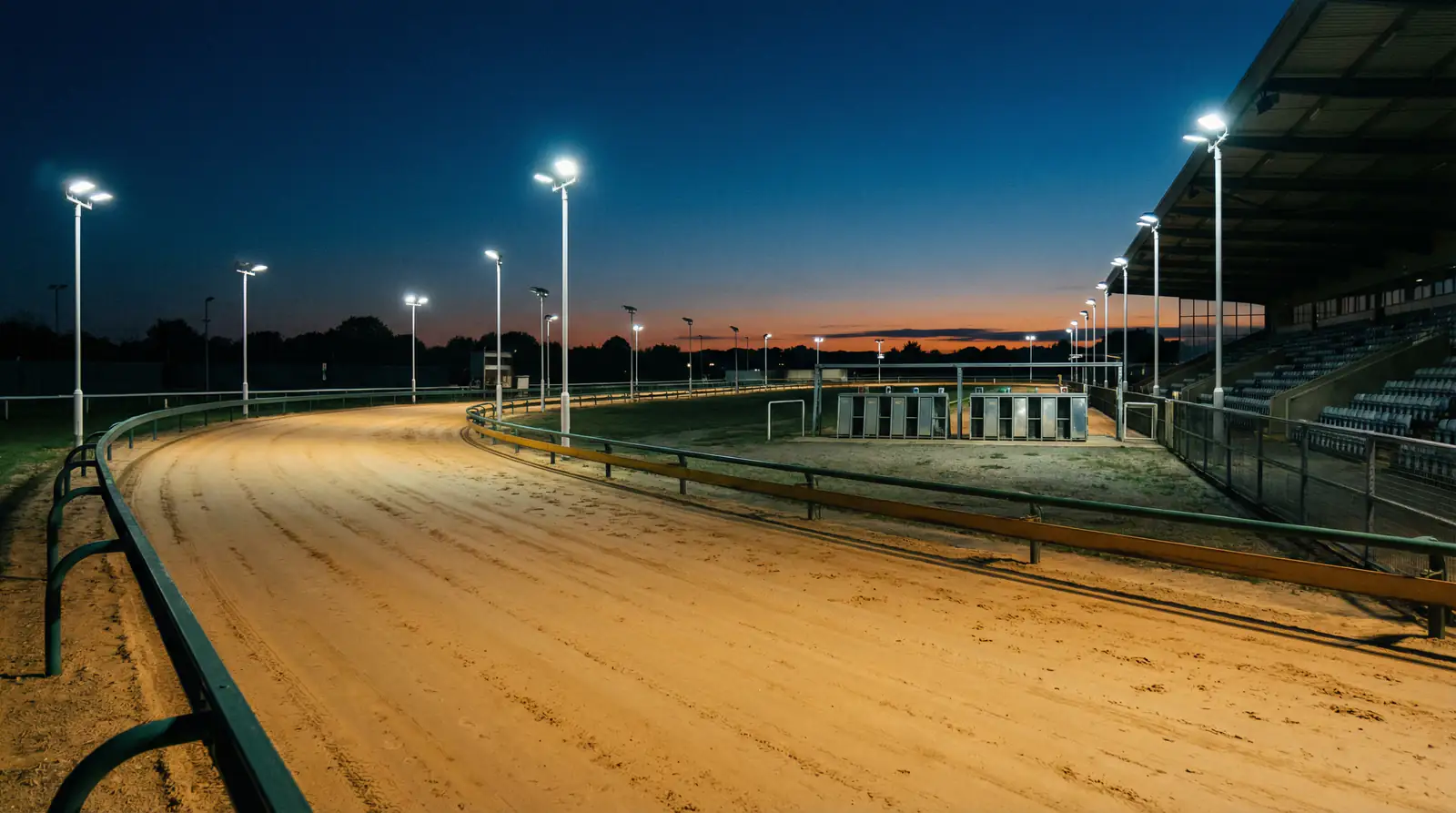
Eighteen Tracks, Eighteen Different Games
Every UK greyhound stadium runs to its own rhythm — same sport, different animal depending on where you are betting. A sprint at Romford bears only a passing resemblance to a sprint at Monmore. The traps are in different positions relative to the first bend, the surface compounds vary, the camber on the turns pushes dogs in different directions, and the distances available shape which type of runner thrives. A punter who ignores these differences is essentially treating every race as interchangeable, and the market will punish that laziness over time.
The UK currently has 18 GBGB-licensed greyhound stadiums staging regulated racing, plus a handful of independent venues — sometimes called flapping tracks — that operate outside the governing body’s framework. The licensed tracks are the ones that matter for serious betting, because their races feed into the form databases, carry official grading, and are covered by the major bookmakers. Each of these eighteen stadiums has characteristics that directly influence race outcomes, and by extension, betting value.
Track knowledge is one of the most underrated edges in greyhound betting. It costs nothing to acquire, requires no subscription or specialist software, and compounds with every meeting you study. A punter who has watched three hundred races at a single track understands things about that venue — which traps produce trouble at the first bend, which distances favour front-runners, how wet weather shifts the bias — that no amount of general form reading can replicate. This guide profiles the UK’s greyhound racing landscape from the major stadiums down to the regional independents, with enough detail to start building that track-specific knowledge wherever you choose to focus.
What Makes Each Greyhound Track Different
Circumference, bend radius, surface — these are not trivia, they are form modifiers. Every physical attribute of a greyhound stadium has a measurable effect on how races unfold, and the differences between venues are large enough to make a dog’s form at one track unreliable at another.
The most fundamental distinction is circuit type. UK greyhound tracks come in two configurations: two-bend and four-bend. A two-bend track is essentially an elongated oval with two tight turns and two long straights. Races over standard distances involve one trip around the circuit. A four-bend track is closer to a full oval loop, with gentler curves and shorter straights. The configuration affects which running styles succeed. Tight two-bend tracks reward early pace and inside draws because the bends come up fast and crowding is concentrated in a short space. Four-bend tracks give wide runners more time to recover lost ground on the straights and tend to produce results that reflect stamina and sustained speed rather than raw trapping ability.
Circumference matters because it determines how much ground a dog covers per lap. A smaller track — say, 380 metres around — means the bends are tighter, the straights are shorter, and the margin for error in the first few seconds is razor-thin. A larger circuit, perhaps 460 or 480 metres, gives the field more room to sort itself out before the first bend, which generally reduces the advantage of inside traps. When a dog switches from a small track to a large one, or vice versa, past form needs to be recalibrated.
Surface is another variable that casual punters overlook. All UK greyhound tracks use sand-based surfaces, but the sand composition, depth and drainage characteristics differ. Some tracks ride fast in dry conditions and slow up dramatically when wet. Others maintain a more consistent speed regardless of weather. A dog that posts quick times on a well-drained surface might struggle at a track that holds moisture and produces a heavier going. Weight data from the race card becomes more relevant in this context — heavier dogs tend to cope better on soft, rain-affected surfaces, while lighter, whippier runners prefer firm going.
Finally, every UK track runs in one direction: all licensed GBGB stadiums are left-handed, meaning the dogs run anticlockwise. This is standardised, unlike horse racing where tracks can be left or right-handed. The consistency means a dog’s rail preference — whether it hugs the inside or runs wide — translates reliably across venues, even though bend tightness and camber differ.
Major UK Greyhound Tracks: Where the Big Races Happen
The stadiums that host the sport’s premier events and draw the deepest betting markets are the ones every serious greyhound punter should know first. These are the venues where open racing reaches its highest level, where the English Greyhound Derby and other major competitions are staged, and where the betting turnover is large enough to produce stable, well-formed markets.
Nottingham is one of the UK’s premier greyhound venues. The Colwick Park stadium hosts major Group and open-race events throughout the year, including the Eclipse. It is a four-bend track with a 500-metre standard trip, a circuit that generally produces fair racing. The extra space on the bends means wide runners are less disadvantaged here than at tighter venues, and the quality of fields at Nottingham’s big meetings makes the form reliable for serious analysis. For punters, Nottingham cards tend to produce competitive races with fewer runaway favourites, which creates opportunities in forecast and tricast markets. The English Greyhound Derby — the most prestigious race in British greyhound racing — is held at Towcester Racecourse in Northamptonshire.
Monmore Green in Wolverhampton is another premier venue with a strong open-race programme. It runs over 480 metres as its standard distance, with a track configuration that slightly favours early-pace dogs drawn on the inside. Monmore hosts the Midland Puppy Derby and regularly stages high-grade invitational events. The track’s compact layout makes the first bend a critical juncture — dogs that get to the turn in front tend to stay there. Trap 1 has historically carried a statistical advantage here, though the margin fluctuates by season and surface condition.
London and South East: Romford, Crayford, Hove
Romford is the closest major track to central London and one of the busiest in the country. It stages regular BAGS meetings that feed the afternoon and evening betting markets, plus higher-profile open-race cards. Romford is a tight two-bend track over 400 metres, and the configuration makes it one of the most trap-bias-sensitive venues in the UK. The run from the traps to the first bend is short, which means dogs in the inside boxes — Traps 1 and 2 — have a clear positional advantage. If they show early pace, they reach the bend first and avoid the crowding that regularly eliminates middle and wide-drawn runners. The flip side is that when a dog drawn wide wins at Romford, it has usually overcome a significant structural disadvantage, which makes that form line stronger than it might appear on paper.
Crayford, also in south-east London, ran over 380 and 540 metres on a tight circuit before closing in January 2025. It was another venue where trap draw was critical. Crayford’s bends came up quickly, and the track favoured handy, early-pace dogs that could find a position before the first turn. The shorter standard trip of 380 metres made it a sprinter’s track. Dogs that previously raced at Crayford and carry form lines from the venue may now appear at other south-east tracks.
Hove, on the south coast near Brighton, is a larger circuit with a slightly more open feel than the London tracks. It stages some of the highest-quality graded racing in the south of England and has hosted major competitions including legs of the Select Stakes. Hove runs over 285, 515 and 695 metres, offering a genuine range of distances. The track’s wider bends reduce trap bias compared to Romford and Crayford, which means form is a better predictor of outcomes than box position alone. For punters looking for a south-east venue where ability tends to triumph over draw, Hove is the natural choice.
Midlands and North: Perry Barr, Monmore, Sheffield, Newcastle
Perry Barr in Birmingham was one of the longest-established greyhound stadiums in England, running over 480 metres on a four-bend circuit. It had a strong Saturday-night open-race tradition and hosted regional finals for several major competitions. Perry Barr closed in August 2025, with its entire greyhound racing operation transferring to the newly built Dunstall Park Greyhound Stadium at Wolverhampton Racecourse, which opened in September 2025. The new venue carries forward the racing programme and trainer base from Perry Barr.
Sheffield occupies a different niche. The Owlerton Stadium runs over 480 metres on a relatively large, open circuit that has historically favoured wide runners and strong finishers. Dogs that struggle at tighter tracks sometimes find their best form at Sheffield because the bends give them room to stride out without being squeezed. The venue also runs over 660 metres, which is one of the longer standard distances available in the UK and produces a different kind of race — slower early pace, more tactical positioning through the middle section, and a long-run finish where stamina matters more than raw speed.
Newcastle, operating from the Byker stadium, is one of the major northern tracks. It runs over 480 metres and stages regular open-race events alongside a strong graded programme. The track has a reputation for fair racing, with no extreme trap bias, which makes it a good venue for form-based punters who want results driven by ability rather than box position. Newcastle’s evening cards draw solid betting turnover, and the form from its higher grades is well-respected across the sport.
Regional and Independent Tracks
The smaller venues are where track knowledge pays the biggest dividends. At Nottingham or Monmore, the market is deep enough that bookmakers price races with reasonable accuracy. At a midweek afternoon meeting in Sunderland, Henlow or Kinsley, the betting markets are thinner, the form is studied by fewer people, and the opportunities for a prepared punter to find mispriced dogs increase substantially.
Sunderland runs over 450 metres on a two-bend track in the north-east. It stages regular BAGS meetings that provide a steady stream of graded racing. The track’s slightly shorter standard trip and tight bends make it another venue where early pace and trap draw carry significant weight. Dogs transferring from 480-metre tracks need to adapt to the shorter distance and sharper turns.
Henlow in Bedfordshire was a four-bend track running over 450 and 660 metres that closed in January 2024. It had a reputation as a fair track where class tended to prevail. Henlow’s graded racing was solid middle-tier, and the form translated well to other four-bend venues. The 660-metre trip attracted staying types and produced races with a different tempo to the standard sprints. Dogs that raced regularly at Henlow may still carry form lines from the venue in their records.
Kinsley in West Yorkshire is one of the smaller licensed venues, running over 462 metres. It has a compact feel and a strong local following. The track’s modest size means familiarity matters — regular dogs at Kinsley develop track knowledge of their own, and that home advantage is real. Punters backing first-time visitors to Kinsley against track specialists should factor in the learning curve.
Other licensed venues worth noting include Doncaster, which stages competitive evening and afternoon cards; Yarmouth, one of the eastern circuit’s main tracks; Sittingbourne in Kent, with a tight two-bend layout; Peterborough, Harlow, and Poole, each with its own distances and characteristics that reward those who take the time to study them. Swindon rounds out the licensed circuit in the south-west.
Independent tracks — sometimes called flapping tracks — sat outside the GBGB framework. They staged unregulated meetings where the grading system, timing standards and form recording were not governed by the same rules. The last independent track in Great Britain closed in March 2025. Dogs that previously raced on the independent circuit and have since moved to licensed venues are essentially unknowns until they establish a GBGB form line. For betting purposes, any historic form from independent tracks is unreliable when comparing to licensed venues.
How to Factor Track Into Your Betting
Knowing the track is half the battle — ignoring it is the most common mistake in greyhound betting. The practical application of track knowledge comes down to three habits that separate informed punters from the rest.
First, check trap statistics for the specific track and distance before every bet. Aggregate trap data is available on sites like Timeform and through some bookmaker race card feeds. What you are looking for is a statistically significant lean — not just a marginal difference over a handful of races, but a persistent pattern across hundreds of results at a given venue. If Trap 1 at Romford wins 22 per cent of 400-metre races over a twelve-month sample while the other traps average 15 to 16 per cent, that is a real bias worth building into your analysis. If the difference is one or two percentage points over thirty races, it is noise.
Second, adjust your expectations when a dog changes venue. A dog that has been running well at Sheffield’s wide, open circuit may struggle at Crayford’s tight bends. The times will not translate directly, the trap draw will carry different weight, and the dog’s running style may or may not suit the new track’s configuration. The first run at a new venue is essentially a trial — it tells you whether the dog can handle the track, but the finishing position is less predictive than usual. Experienced punters often watch a dog’s first run at an unfamiliar track and only bet on it from the second outing onward, once the data includes a venue-specific form line.
Third, pay attention to how going conditions affect each track differently. Rain at Monmore might slow times by 0.2 seconds; the same rain at a track with poorer drainage could add 0.5 seconds and completely alter the competitive balance. Dogs that cope well on heavy going become significantly more valuable at tracks where wet weather has the most dramatic effect. Conversely, dry, fast conditions tend to narrow the field and favour speed over durability. Keeping a mental map of how each track responds to weather gives you an edge that most casual bettors simply do not possess.
UK Greyhound Racing Schedule: When Tracks Run
Not every track races every day — there is a weekly pattern, and understanding it helps you plan your betting rather than react to whatever happens to be on.
UK greyhound racing broadly divides into two types of meeting: BAGS (Bookmakers’ Afternoon Greyhound Service) and open/feature racing. BAGS meetings are the bread and butter of the sport, staged at various tracks throughout the week, often in the afternoon, specifically to provide betting content for bookmakers. These are almost exclusively graded races — A1 through to the lower tiers — and they are the meetings that appear on most bookmaker platforms from around lunchtime onward. The racing is competitive within its grade, but the calibre is generally lower than feature meetings.
Evening meetings, particularly at weekends, tend to carry higher-quality cards. Saturday nights at venues like Perry Barr, Monmore and Nottingham often include open races and semi-finals or finals of major competitions. These cards attract stronger fields, deeper betting markets and more attention from the form-studying community. If you are looking for races where the market is most efficient — and therefore hardest to beat — the Saturday evening premier meetings are it. Conversely, if you want races where track knowledge and form reading can give you a genuine edge over a thinner market, the Tuesday or Wednesday afternoon BAGS cards at regional venues are where the value tends to sit.
The weekly rhythm varies by venue. Some tracks run three or four times a week; others stage meetings twice weekly or even less. The GBGB publishes a fixture list, and most data platforms display upcoming meetings. A useful practice is to identify which tracks race on which days and build your study routine around a fixed schedule — for example, if your chosen track runs on Monday evenings and Thursday afternoons, those become your form-study windows. Consistency beats volume. Watching the same track twice a week teaches you more than dipping into six different venues once a month.
Major events follow a seasonal calendar. The English Greyhound Derby runs in the late spring and early summer, typically with first-round heats in May and the final in June at Towcester. Other major competitions — the St Leger, the Oaks, the Puppy Derby — are spread across the year. These events are worth following even if you do not bet on them, because the form lines they produce are high-quality data points that feed into open-race analysis for weeks afterward.
One Track, One Edge
The punter who knows one track inside out will always outperform the one who dabbles across eighteen. This is not a theory — it is the most consistent finding among profitable greyhound bettors. Specialisation works because greyhound racing is a sport of small margins. The difference between a good bet and a bad one is often a single piece of track-specific information: which trap is favoured at that distance, how the surface rides after a day of rain, whether a particular dog has shown discomfort on tight bends before.
Choosing your track is the first strategic decision. Pick a venue that stages regular meetings — at least twice a week — so you have enough data to build a meaningful picture. Ideally, choose a track you can attend in person occasionally, because watching live racing gives you context that screen-based form study cannot fully replicate: how the hare runs, how the track surface looks, how dogs behave in the parade ring. But even without attending, regular remote study of a single venue across fifty, a hundred, two hundred meetings will put you ahead of the vast majority of casual punters.
Everything else in greyhound betting — form reading, bet selection, staking — works better when it is built on a foundation of track knowledge. Start with the venue, learn its peculiarities, and let the rest of your method grow from there.