

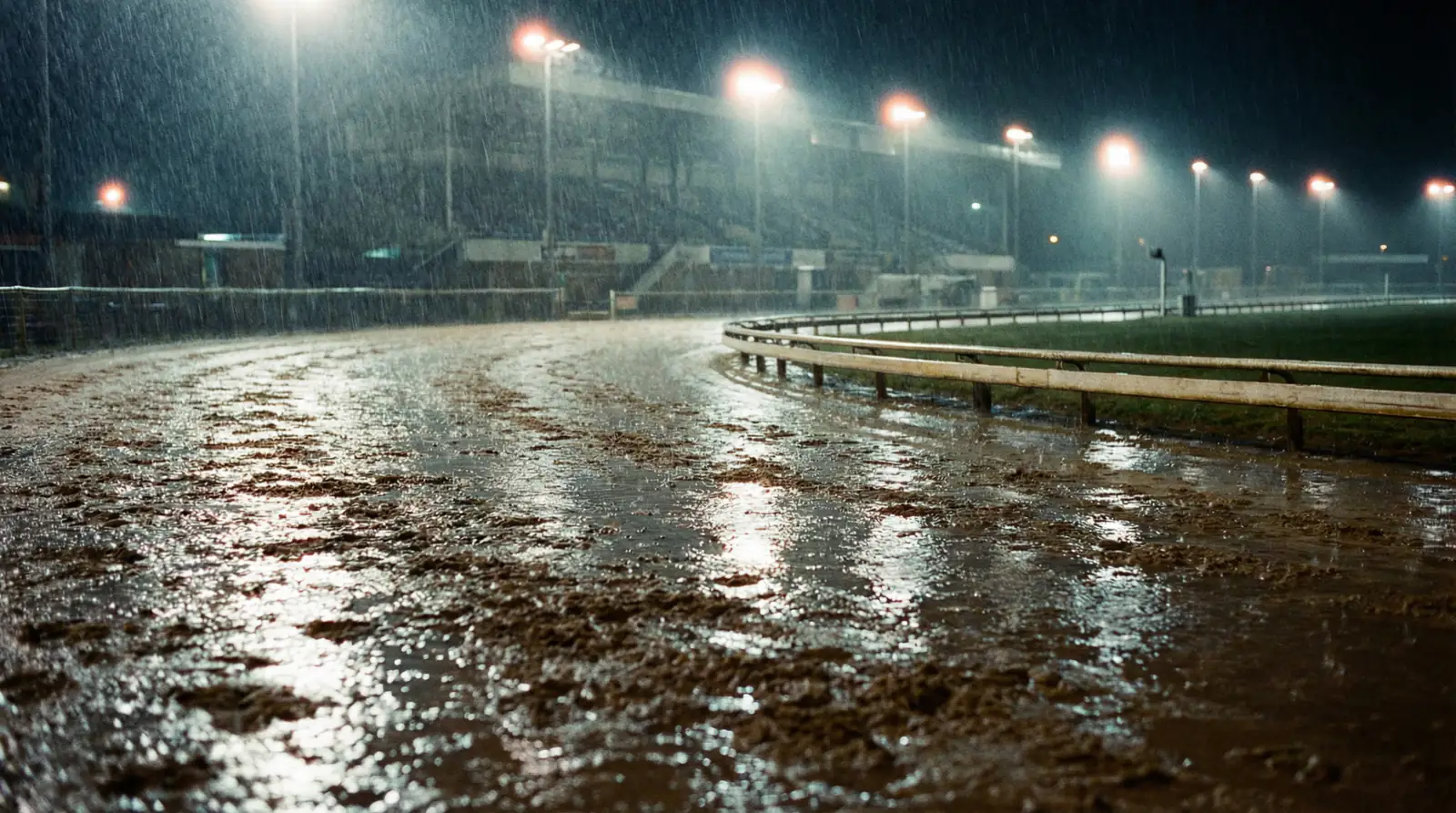
Rain Doesn’t Cancel Greyhound Racing — It Reshuffles It
Greyhound racing in the UK runs through virtually every weather condition short of a genuine safety hazard. Meetings are rarely abandoned for rain, wind, or cold — the sand-based surfaces that most tracks use are designed to drain and remain runnable in wet conditions. What weather does, though, is change how the track behaves, and that change has a measurable effect on race outcomes, running times, and which types of dogs gain or lose an advantage.
For punters who base their selections on form data recorded in different conditions, weather is the variable that can make a strong form line misleading. A dog that posted a fast 29.1-second 480-metre time last week did so on a specific surface state. If tonight’s card runs on a rain-soaked track where every time is half a second slower, that 29.1 is not directly comparable. The dog might still be the fastest in the race — or a heavier dog with a grinding running style might handle the conditions better and close the gap.
The punters who consistently account for weather are working with a more accurate picture than those who treat all form as equal regardless of when and how it was recorded. Weather is not an exotic angle. It is a fundamental condition that shapes every race, and ignoring it is the same as reading half the form book.
How Wet Conditions Change Track Performance
Rain is the single most impactful weather variable in UK greyhound racing. The sand surfaces that most stadiums use absorb water and change character as they do. A dry sand track is fast, firm, and rewards dogs with high top-end speed. A wet sand track is heavier, slower, and demands more physical effort to maintain pace through the bends. The transition between these states can happen within a single evening if rain arrives mid-meeting, which means conditions for race one and race twelve on the same card might be materially different.
The first and most visible effect of rain is on running times. A track that produces standard 480-metre times of around 29.0 seconds in dry conditions might see those times extend to 29.5 or 29.8 in heavy rain. The slowdown is not uniform — some dogs handle wet surfaces better than others, and the dogs that lose the least time in the wet are often not the same ones that post the quickest times in the dry. This creates a reshuffling of competitive order that the form book does not automatically adjust for.
Heavier dogs tend to cope better on wet tracks. The extra weight provides more traction on a softer surface, allowing them to maintain drive through the bends where lighter dogs can lose grip and slide wider than their normal running line. This is not an absolute rule — there are light dogs that handle wet sand perfectly well — but as a population-level trend, it is consistent enough to be useful. If the going is heavy and you are choosing between two dogs of similar form, the heavier one has a structural advantage that the racecard weight figures can help you identify.
Wet conditions also affect trap bias. The inside rail at many tracks becomes less advantageous in the rain because water tends to pool or drain towards the inside of the bends, making the rail the heaviest part of the running surface. Dogs that normally benefit from hugging the rail may find themselves running on the slowest ground, while dogs that naturally take a wider line avoid the worst of the wet. At some stadiums, persistent rain effectively flips the normal trap bias — outside traps gain ground, inside traps lose it. Punters who track trap bias data by going conditions can spot these inversions and adjust their selections accordingly.
Standing water is the extreme case. If rain is heavy enough to create visible puddles on the running surface, the track is approaching unsafe conditions and the meeting may be delayed or abandoned. Short of that point, standing water in localised areas — particularly on the bends — creates unpredictable patches where a dog can lose footing. These conditions introduce randomness that no amount of form study can account for, and experienced punters reduce their exposure on nights when the track is visibly waterlogged.
Wind, Temperature and Seasonal Factors
Wind is the second most underrated weather factor in greyhound racing. Dogs run at speeds exceeding 40 miles per hour, which means a strong headwind on the back straight has a genuine braking effect, while a tailwind can produce times that look faster than the dog’s actual ability warrants. The effect is most pronounced in sprint races, where the dogs spend a higher proportion of the race on the straight and less time on the bends where wind direction shifts relative to the running line.
At most UK tracks, the prevailing wind direction interacts with the track layout in a predictable way. A stadium where the back straight runs north to south will experience different wind effects depending on whether the breeze is coming from the north, south, or sideways. Punters who attend a specific track regularly develop an intuitive feel for how wind affects racing there. For those betting remotely, checking the wind speed and direction before a meeting and comparing it to the track orientation is a minor effort that can explain why times on a given night are faster or slower than expected.
Temperature affects both the dogs and the surface. Greyhounds are lean, short-coated animals with minimal body fat, which makes them sensitive to cold. In winter meetings run in near-freezing temperatures, some dogs perform below their usual standard simply because they are physically uncomfortable. Others cope well. There is no universal rule, but trainers who kennel their dogs in heated environments and transport them in insulated trailers tend to produce more consistent winter results than those whose dogs arrive cold.
The sand surface itself behaves differently across seasons. Winter surfaces tend to be heavier due to accumulated moisture, even on nights when it is not actively raining. Summer surfaces are typically faster and firmer, which produces quicker times and makes speed-focused dogs more effective. The transition periods — early autumn when the first sustained rain arrives, and late spring when the ground dries out — are the windows where track conditions change most rapidly and where form recorded a month earlier is least reliable as a guide.
Adjusting Your Bets for Weather Conditions
The practical application of weather analysis comes down to adjusting your confidence in form figures and shifting your expectations about which dogs will benefit. It is not a separate system — it is a filter that sits on top of your existing form assessment and modifies it based on tonight’s conditions.
Start by checking the weather before the meeting. Not just whether it is raining, but how long it has been raining, how heavy the fall is, and whether the track had time to dry since the last wet spell. A track that was rained on overnight but has had twelve hours of dry weather before an evening card will ride differently from a track that is being rained on during the meeting itself. The former is likely to be on the slow side of normal. The latter is getting progressively heavier as the night goes on, which means later races on the card run on worse ground than earlier ones.
When conditions are wet, increase your weighting on dogs with higher body weight and proven wet-track form. If a dog has previously raced on a wet surface at the same track and maintained its performance, that is concrete evidence of its ability to handle the going. If a dog has no wet-track form, you are guessing about its suitability, and guessing should lower your staking rather than maintain it.
Consider reducing your overall activity on nights with extreme weather. Heavy rain, strong wind, or freezing temperatures all introduce variables that make race outcomes less predictable. The edge you build from form analysis is most reliable in standard conditions, and it degrades as conditions become more unusual. There is no shame in sitting out a meeting that you assess as too weather-affected to read accurately. The races will still be there tomorrow, in conditions you can better evaluate.
For punters who specialise in a single track, building a personal weather log is one of the most valuable long-term investments available. Record the going conditions at each meeting alongside the results and times. Over a few months, patterns will emerge: which traps gain or lose in the wet, which trainers produce better results in cold weather, which dogs consistently run closer to their form when conditions deteriorate. That log becomes your own private dataset, and it gives you an advantage that cannot be replicated by anyone who has not done the same work.
Check the Forecast Before You Check the Form
The weather forecast is free, takes thirty seconds to check, and directly affects the reliability of every form figure you are about to analyse. It is one of the smallest investments of time in greyhound betting and one of the most frequently skipped. Punters who study form for twenty minutes and never glance at the weather are building their assessment on an incomplete foundation.
Weather does not override form — the best dog in the race is usually still the best dog regardless of conditions. But it shifts the margins. It turns a clear favourite into a vulnerable one. It gives a heavier, slower dog a surface advantage that its form alone would not justify. It changes how bends ride, which changes trap bias, which changes the expected pace of the race. Every link in the analytical chain is touched by conditions, and none of those links update themselves automatically.
Make it a habit: check the forecast before you open the racecard. If conditions are standard, proceed as normal. If they are not, ask yourself which dogs benefit, which dogs suffer, and whether the market has adjusted. That sequence takes less than a minute and is worth more than any amount of form study conducted in a weather-blind vacuum.
Get more race analysis at greyhoundresultsyester.
Also read our greyhound sectional times.
